Super-Soldier Ants

Over at The Register:

Ants can grow from larvae into many different bodily types, including soldiers, workers, or queens, depending on how they are fed and raised within the colony. The team analyzed the genetic structure of the supersoldiers and found the mechanism for their growth, a juvenile hormone.

When the team applied the hormone to larvae from these species, they found it easy to create the super soldiers. The surprise came when they tried a similar technique with species that don’t normally produce such heavy soldiers. They found that they could still create supersoldiers in these species, by activating genotypes from a common ancestor of the pheidole genus.

Ah, meat and bread for the science fiction writer. Sort of makes me think about Pournelle and Niven’s The Mote in God’s Eye. It also makes me think about a battle version of the Brumallians in Hilldiggers.

About Those Breast Implants…

So, the moment I heard this story about possible problems with industrial-grade silicon breast implants my knee-jerk reaction was, ‘Hey, you wanna buy bigger tits in France then that’s your problem and I shouldn’t have to pay for it!’ Then I thought about it for a bit and completely changed my mind. I’m guessing that someone who has shelled out for breast implants in France is someone with cash to spare on cosmetic surgery and is unlikely to be a dole scrounging parasite. Therefore, it is probably the case that they’ve been paying into the NHS, and quite likely they have paid in a damned sight more than they’ve had in return, so why shouldn’t they have medical care if there’s a problem with those implants?

NHS doctors do not have the right to lecture us on our lifestyle choices or refuse care. They especially do not have that right when we are forced to pay them. I’ve written this before but I’ll write it again: it is like going into a chemist’s to buy Aspirin, paying your money, then being asked why you need the pills. When you say you have a hangover the assistant replies, ‘You shouldn’t drink so much and, because you have, that’s your own fault so I’m not giving you your Aspirin, but I’m keeping your money.’

Of course while this has been going on some NHS berk was on TV connecting these breast implants to smoking and drinking. ‘The NHS has to pay for smokers and drinkers!’ she said, righteously offended. Okay, so the NHS has gone out and earned its own money has it? And it is now having to shell out on those evil smokers and drinkers is it? Erm, no, Mrs NHS Berk, that’s OUR money you’ve got there. We gave it to you on the basis that you would look after us when we’re ill. I don’t recollect anything about you being able to pillory people who aren’t behaving as you would wish. You can’t start changing the rules after the fact.

Incidentally, smokers provide huge revenue for the government and, no matter how the righteous try to twist the figures, they cost the NHS less than non-smokers. Did you think dying young was more expensive than the cost keeping you dribbling and in incontinence pants in an OAP home?  

This is a long and slippery slope, whatever your opinion about smoking and drinking, or fat people (or rather, how much you have responded to the constant indoctrination, de-normalization and demonization from NGOs, government and the NHS itself). Where does it stop? Why, for example, should we pay for the rescue and care of a climber who has fallen off a mountain? Why should we pay for any sports injury? Why should we pay for maternity stuff and childcare? I mean, having children is a lifestyle choice nowadays, isn’t it? Why should we pay for that guy cutting off his finger – he obviously wasn’t paying attention when using that Stanley knife. Why should we pay for that woman with malaria? It’s her fault she went on holiday. Why should we pay for that guy with AIDs? He should have used a condom. In fact, on that basis, we shouldn’t pay for any STDs.

And so continue the excuses for refusing treatment because a socialist experiment is, as always, running out of money.

The NHS was supposed to be free for all UK citizens at the point of use, but it is not. Foreigners get treatment they’ve paid nothing towards. We get charged exorbitant prices for medications that can be bought over-the-counter in other countries for a fraction of the cost. NHS dental care costs the same as private dental care elsewhere. Prescription charges are uneven, applying in England but not if you happen to live anywhere else in the UK. The NHS should be broken up and privatised and the only enforced requirement for UK citizens should be medical insurance, which would lead to real choices about your medical care. And, if that happened, the dependence on customer money rather than ‘free government money’ would rapidly shut up such righteous pricks like Mrs NHS Berk.

The Girl With the Dragon Tattoo

We went to watch The Girl with the Dragon Tattoo yesterday – a film we were looking forward to after seeing that Daniel Craig was in it, and after one glimpse at the actress playing Lisbeth Salander. The title sequence was gobsmacking: James Bondish but in an oily and dark and somewhat disturbing way, thereafter I found the music a bit annoying at first and got that feeling of, ‘Oh dear, they’re doing the intrusive music to cover the crap content,’ but this turned out not to be the case.

As Blomkvist Daniel Craig was excellent, but then he’s excellent in just about any role he takes, though of course he is always Daniel Craig. I’d add that he was excellent in Quantum of Solace and that the reason the film was crap had more to do with the story and direction. Rooney Mara, as Salander, was simply brilliant. I think my criticism of the Swedish version was that both these roles weren’t filled adequately and, certainly, the Salander of that version wasn’t anywhere near enough as edgy, dangerous and disturbing. I reckon it was Mara’s bleached eyebrows that tipped it. The rest of the cast were great too. Christopher Plumber of course could be relied on to deliver the goods, and Salander’s new guardian did a very good job of being thoroughly detestable.

I could see where bits of the book had been excised and I could understand the reasons why. A large book of course has to be cut to fit into the film format and the need for the plot to head in a relatively straight line to the end. I was slightly annoyed by the cutting of what I will call the ‘Australian bit’ but even then could see why it might have been removed. It didn’t fit the tone and texture of the film and was, in essence, after the dramatic ending – subtext.

Thoroughly recommended.  

Writing Update

And another 2,000+ words written today. How many times should I repeat this before you all get bored with it? Anyway, I’ve now reached the stage where I’ve got nine sections, or episodes of the story, chronologically ordered in a large lump of text 17,000 or so words long over 26 pages. I also have a contents list which details what I have, with one brief line describing each section. (I use this list to keep track of the story. I then copy it when I’ve finished and convert it first into a long synopsis, then that into a short synopsis, then that into cover blurbs)

Now it’s time to start deciding how I’m going to structure the book. Usually I divide up what I’ve written into about ten pages per chapter, but in this case I might be working slightly differently, in fact more like I did with Brass Man. A lot of what I am writing now is, essentially, backstory. I’m considering making these sections into ‘retroacts’ to start off each chapter, or to insert where relevant in the current story as reveals. This backstory also comes from two perspectives, so there will also be opportunities, in those reveals, to show stark contrasts.

So far as I plan, the story itself begins during the prador/human war (that backstory), then continues just after the events on Masada in The Technician. So far. Maybe I’ll end up just writing my way through to that point, I’m certainly enjoying myself at the moment. And maybe you’ll end up with more than one book.

Resolution … well, sort of.

At last, Christmas is over, the New Year is beginning and I can get on… I quite often feel like that at this time of year and, since this is resolution time, many other do too. Now the compulsory gorging, socialising and alcohol excess has come to an end. Now it’s time to sober up and look at the costs.

The first cost I noted last night. Unable to get to sleep I sat up reading a book. While reading I looked down at my torso and noted that it’s measurement front to back is now more than the one from side to side. This is despite doing twenty sit-ups and press-ups every morning for months, and cycling 16 to 24 miles a week. It really is time for me to do something about my big fat gut.

January is our zero alcohol month so that’ll knock off the calories, prove to myself that I’m not an unrecoverable alcoholic and allow my liver to recover… Then again, I read recently an article titled ‘Janopause detox does more harm than good’. Apparently ‘doctors say’ this is medically futile and fails to rejuvenate the liver. Yet, the liver does regenerate very quickly so how can a month off the booze not be a good thing? Of course, reading between the lines it soon becomes evident that this is an article patched together by the anti-alcohol lobby – the kind of people who want the pointless minimum pricing on alcohol. Taking a month off apparently encourages people, who are of course all idiots, to think that they are immune to the effects of alcohol for the rest of the year. And we must all stick to the government advised limit on alcohol units … oh yeah, let’s revisit that (have to pay to see it now):

The safe limits were introduced in 1987 after the Royal College of Physicians produced its first health report on alcohol misuse. In A Great and Growing Evil: The Medical Consequences of Alcohol Abuse, the college warned that a host of medical problems – including liver disease, strokes, heart disease, brain disease and infertility – were associated with excessive drinking. The report was the most significant study into alcohol-related disorders to date.


But Richard Smith, the former editor of the British Medical Journal and a member of the college’s working party on alcohol, told The Times yesterday that the figures were not based on any clear evidence. He remembers “rather vividly” what happened when the discussion came round to whether the group should recommend safe limits for men and women.

“David Barker was the epidemiologist on the committee and his line was that ‘We don’t really have any decent data whatsoever. It’s impossible to say what’s safe and what isn’t’.

“And other people said, ‘Well, that’s not much use. If somebody comes to see you and says ‘What can I safely drink?’ you can’t say ‘Well, we’ve no evidence. Come back in 20 years and we’ll let you know’. So the feeling was that we ought to come up with something. So those limits were really plucked out of the air. They weren’t really based on any firm evidence at all.

In fact, take a look at this bit of QI on this matter, then google the subject and try to find anything about this in the righteous bansturbation proliferating across the Internet.

I’ll also be ramping up the exercise and cutting down on what I stick in my mouth. I often start this off by spending a day eating nothing – the next day finding I’m no more hungry in the morning than I was the day before – thereafter, eating less and having further ‘days off’ like this shrinks my stomach so I just don’t feel as hungry. Of course this is, apparently, a bad thing to do too. I disagree. What the hell is fat for? It is a way of storing up calories for lean times. So what happens if you don’t eat? You burn up fat rather than the half a pack of chocolate biscuits you ate last night. It’s quite a simple equation.

Okay, I’m off for a cycle now.  

Conflicts

Nice review of Conflicts here.

Neal Asher’s “The Cuisinart Effect” is a romp equal to the earlier story from Andy Remic. A hard-nosed officer leads a group of soldiers into the distant past in order to foil their enemy’s plot to kidnap dinosaurs and use them as weapons of mass destruction. (Wow. The sentences I type sometimes.) The dinosaurs are, of course, awesome. And they provide an excellent backdrop for the story’s real conflict: the inhuman “by the book” officer versus the flawed but empathetic soldiers. I’m not familiar with Mr. Asher’s other work, but got the impression that this was linked into an existing world. I’m sure I missed a few nuances because of that, but, whatever. Dinosaurs.

Another Interview

Here’s a recent interview with me conducted by Douglas R Cobb. I’m probably repeating a lot of stuff considering how many of these I’ve done.

Different SF writers have different names for their interstellar civilization. Ian M Banks has the Culture, Star trek has the Federation and the Dominion, empires and kingdoms have been used too. The Polity was my own particular take on this. I wanted something big, sprawling and complicated in which I could set just about any SF story. Its inception was in numerous short stories where similar technology might be used, similar alien life, agents, characters and gradually grew almost like a crystal forming. Runcible gates where a hat-tip to the ansible, but grew into a science whose nomenclature evolved from the poem The Owl and the Pussycat by Edward Lear (a tachyon, for example, is called ‘pea-green’). I wanted my Polity linked up by spaceships and instantaneous matter transmission and the runcible gates are the latter, giving people the ability to step across light-years in an instant.

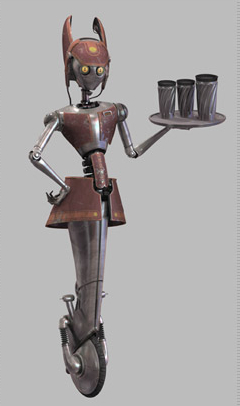
Where's My Robot Butler?

I’ve been watching some You Tube videos and reading up on some stuff about the ‘technological singularity’. Vernor Vinge’s ideas about this relate more to an explosion in technological development brought about by artificial intelligence, but there are other definitions out there. I was watching one video in which someone tracked the doubling of technological development from two thousand years ago and posited that the first doubling came in about 1600 (I think) and that successive doublings have been getting closer together so we’ve now reached the point where it happens once a year. Following this exponential curve we can suppose that we’ll reach a point where we get doublings every hour.

Without artificial intelligence we’re getting a ramping up of technological development through the Internet. Scientist, technicians and engineers can now communicate instantly, all over the world, which is certainly accelerating things. Ideas can propagate worldwide as fast as someone can type. Admittedly this can also apply to silly ideas following the axiom that a lie can circle the world faster than the truth can get its boots on, but silly ideas can also be torn apart quickly because a lot of brains are at work – the stupidity of crowds is countered by the synergetic intelligence of the Internet (a kind of artificial intelligence, if you like).

But putting all this aside I began pondering on how often now I keep getting those, ‘Hang on a minute’ moments. I love reading the kind of stuff that can be found on The Next Big Future, just as I enjoyed reading about them in science magazines a few decades ago. But my wish is to see these wonderful things actually reaching people and more and more now I’m seeing it happening. Yes, we have the Internet, all those mobile phones and all that instantly accessible data; all that computing power, music, graphics and games. But where’s my robot butler? Where are the physical as opposed to media/communication advances? Where is the hardware that does more than just shuffle about information and actually uses it in the physical world? Deep Blue might have beaten Kasparov at chess, but was incapable of moving its own pieces.

Some car adverts spring to mind. We have the cars that don’t need keys, use voice recognition, can recognize traffic signs and can park themselves. This is quite stunning for someone whose first car was a Vauxhall Viva loaded with filler and driven to the scrapyard after three months. This springs to mind. I used to run and program a big CNC milling machine, which was cool, but now it seems the technology is being developed to ‘print’ solid objects. How long, I wonder, before we’ll be able buy something similar to connect up to a home pc? Then there’s exponential increase in the speed DNA is being sequenced

These are just a few of those developments, which I expect we’ll be seeing more of, where the virtual is becoming actual; where information technology is reaching out into the real world. I could spend days on the Internet finding more examples; where the computers are actually being given ‘hands’, but I won’t.

Can you think of some more?

Website Updates

I decided a number of days ago to put some extras on the website but for three or four days have been unable to upload anything. No explanations from Virgin – I suspect they were either overloaded or doing some maintenance.

I’ve now added a my SFF collection to Galleries and the ‘scooby’ ending on Gridlinked (this latter was an ending that was taken out during the editorial stages of the book because it was too much like a Scooby-Doo explanation).

Even with all the additions the website is only 11.4 megabytes so I will keep adding to it as time goes on. Any suggestions as to what you might like to see there?