On Writing: Look!

Jack looked across at her with a pensive look on his face.
‘You look like you’ve seen a ghost,’ he said.
‘It looked like a ghost,’ she replied, then looking past him she cried, ‘Look out!’

I was about to write that the above is a huge exaggeration of my long-time love affair with the utility of the word ‘look’ but, having spent some time editing The Parasite, I’m not so sure it is. This was one tendency of mine that my editor Peter Lavery picked up on, and it’s one that displays the differences between the three vocabularies. You have your reading, writing and speaking vocabularies which, respectively, are in descending order of size. There were of course many words other than ‘look’ I could have used. All of them were sitting there in my reading vocabulary, but I just wasn’t using them.

It seemed to come as a revelation to me that someone might ‘peer, gaze, glance, stare or peek’ at something, or that they might ‘watch, study, observe or regard’ something, or that there were alternatives to ‘look like’ or ‘looked like’. I could go on and on but any of you reading this in the hope of picking up a tip or two are all probably using Word and have access to a thesaurus. Highlight ‘look’ and take a look at scrutinize the many alternative words that are available.

But of course that is not enough. Words like this are those we are often blind to, so we need to either pore over our work anew, or have someone else take a look at it examine it. Our words need to be closely inspected, contemplated and studied. ‘Look’ is useful, but does it have the nuance of meaning of the alternatives? Does it have the gravitas of ‘regard’, the brevity of ‘glance’, the myopia of ‘peer’ or the analytical inference of ‘study’?

Note: Generally you don’t have your character ‘peer’ at the one he’s deeply in love with, or ‘gaze’ at the plans to the bank vault he’s about to raid, and he doesn’t ‘examine’ the view … unless of course you’re trying to twist and tweak something, or maybe work in some character-building. The half-blind lover might peer. The inept bank robber might gaze (probably with bafflement) at those vault plans. And the cold military commander might examine the view.

Here’s a suggestion: take a paragraph of your work and go through it word by word checking it against your thesaurus. I bet you will find at least one word you would like to change – one word that adds meaning by simple replacement.

Jack gazed across at her, his expression pensive.
‘You look like you’ve seen a ghost,’ he said.
‘It seemed like a ghost,’ she replied, then glancing past him she cried, ‘Watch out!’

5 Desert Island Reads — Hitch

Firstly, oh my god this is hard! Five isn’t enough! I just hope the rest of my books somehow float my way.

Ok. My five, based on re-readabilty, memories and keeping my sanity whilst I survive on Coconut Vodka and Banana Daiquiris:

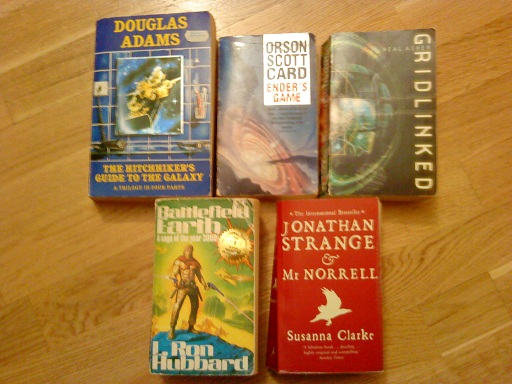
1) The Hitchhikers Guide to the Galaxy. Ironic, Witty, Hilarious, Genius. A book and a tale I have read and listenned to for many years wrote by a man who once shook my hand and made me very nearly find religion, though perhaps not the kind that Pope dude would enjoy! I have read the entire series so many times I cannot count the number and it is the #1 choice for me if stuck on a desert island.

2) Ender’s Game. Some love it, some hate it. I adore it and find the personalities and social ingenuity involved, brilliant. Like all the books here, it make my brain come alive and see IMAX in my head. I first read it fairly recently, Emma had it and I’d heard of it but never read it. Then I moved to her place and slowly worked my way around her bookcase and found, for me, and instant classic.

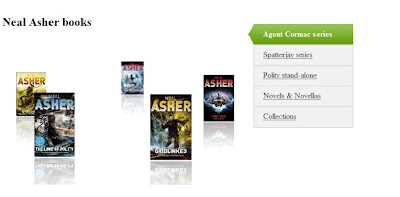
3) Gridlinked. Has to be that one. I love Cowl, I love The Skinner and the rest but to me Gridlinked is the best. It was my introduction to Neal and was right down my alley with its license to kill Agent Cormac. A thrill ride all the way with enough sub plots and twists to make me read over and over. This one I would read when I started to feel my first dose of apathy, to kick start me back into surviving.

4) Battlefield Earth. I know, I know, and I do not care. The author was a complete nut job, this is now certain. The writing isn’t even that good and is very simplistic and child like in parts but its one of the first ‘proper’ Sci-Fi books I read as I got older and I fucking love it. In my opinion only the Revelation Space series has come close to the epic scope of humanity this book offers. Everytime I read it my childhood comes back and I dream of Flash Gordon.

5) Jonathan Strange and Mr Norrell. The GF hates this book, with a passion, one that I cannot understand. In terms of writing this is, to me, the best book I have ever read. The alternate past in which it lives is one I dearly wish was the real one. I don’t tend to enjoy ‘fantasy’ books but then again I don’t rate this as fantasy. Its about magic, yes, but more than that, its about the Magicians and once I pick this up I cannot fail to read from the miniscule starts to the fatalistic ends of the key characters. My only regret is that Susanna Clarke seems to be a one hit wonder, but then again it means I don’t have to sneak another book onto the island!

I will say this. If ever stranded on an island with just these five books, I would survive, partly due to them. I would also be found crying at night over everything else I had to leave behind and missed, a lot of those tears would be over Clarke, Reynolds, Gaiman, Pratchett… Oh god, the list is endless.

/me waves to a passing ship and begs a look at the library.

Hitch.
No Smoking Day!

It being ‘no smoking day’ today my first reaction was to roll myself a nice Old Holborn rollie and puff away contentedly. Luckily for them I’m not going anywhere today so won’t encounter any of the righteous pricks who are pushing this. Any requests to stub it out would have been immediately acceded to, right in the eye of the one asking.

Dick Puddlecote puts it better than me:

What we really need, of course, is a ‘Keep Your Big Fat Interfering Nose Out Of Other People’s Business Day’, but there’s no cash for fake charities in that idea.

Borders in Wellington

One here from Rob Clubley out of Borders in Wellington New Zealand. They’re still running? Here’s Rob’s blog and website.

Five years ago Caroline and I took a trip to New Zealand. We wandered around Christchurch to eventually find a book shop with a nice stack of my books. I signed them, and signed a wall in the shop covered with author signatures. I have to wonder if that wall is still standing.

Kindle Kimota

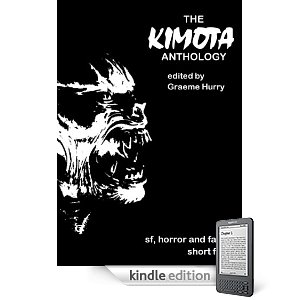
Graeme Hurry’s Kimota was one of the many small press magazines in which my stories were published, in the days before I was a fat, rich and famous author. The short stories of mine he published are Alternative Hospital, Gurnard, The Torbeast’s Prison, Tiger Tiger and the original booklet of the Mason’s Rats stories. Now he’s publishing Kimota on Kindle – this issue containing Alternative Hospital and stories from other Kimota authors.

You can find it here.

5 Desert Island Reads — Rob Dalby

Hi Neal

It’s proved incredibly difficult to cut this down to five, and since two of the five would have been yours (The Skinner and The Technician) I decided to arbitrarily exclude your stuff in order to not look too much like I was blowing smoke up your you-know what..

Others bubbling under the top five would be David Brin’s Brightness Reef (representing it’s trilogy), The Illium and Olympos duet by Dan Simmons (as well as his The Terror which I think is Sci-Fi for reasons too complicated to go into here) and Chris Wooding’s Retribution Falls.

Anyway, on to the five.

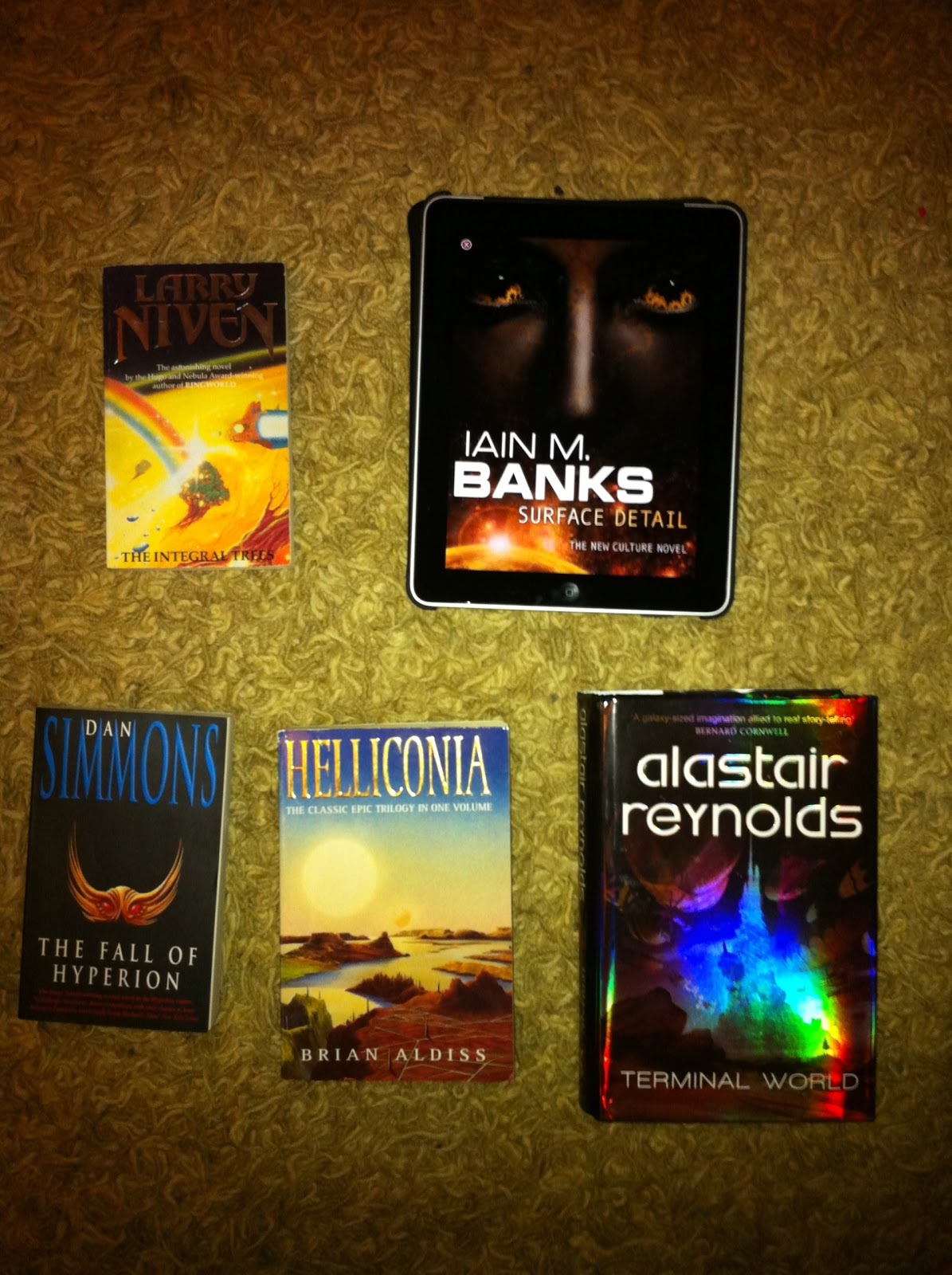
The Integral Trees by Larry Niven.
One of Larry’s lesser known works (along with it’s sequel The Smoke Ring) and from the period when he was arguably past his best, but for me the story of Sharls Davis Kendy, Checker of the starship Discipline, keeping his ancient watching brief shows that Niven’s huge imagination was still as fertile as ever, with it’s description of a long-lost society of humans growing up among the bizarre vegetation and creatures of a gas torus.

The Fall of Hyperion by Dan Simmons
To some extent this is representing it’s three siblings (Hyperion, Endymion and The Rise of Endymion) but this one is my favourite of the four. Simmons has a remarkable talent in creating an entire , fully realised, civilisation within a single novel where others might take a whole sequence to get to the same amount of detail, and the world of the Hegemony of Man is one which we would love to live in, at least until we find there is a worm buried in the apple. It’s crammed with breath-taking vignettes, and I’ve been haunted by the final choice of Hegemony CEO Meina Gladstone since I first read the book getting on for 20 years ago.

Helliconia by Brian Aldiss
Perhaps cheating a little here, but my version of The Grand Old Man of British Sci-fi’s best work has all three volumes of the Heliconia cycle in one book, so I am having it as one of my five. There is a wonderful sense of momentum – the slow tumbling cycle of history, in the complex dance of the two stars of the Heliconia system and the effects the resulting centuries-long seasons have on the fortunes of the two sentient species of the world. There are discomforting parallels (for me) between the way our society seems to be developing and the parallel story of the deteriorating Human mission to Heliconia observing the planet below from their space station.

Terminal World by Alastair Reynolds
For me the mark of great Sci-FI is to create so compelling a world that as soon as you put down the book you want to know what happens next – want to go back there. I’d hate to think that Reynolds might not revisit the remarkable society of the Terminal World, which he leaves with many questions unanswered. Much of the pleasure in the book comes from following the clues Reynolds leaves as to the real nature of the world he is describing.

Surface Detail by Iain M Banks
A return to form for Banks, whose sci-fi output has been (for me at least) disappointing of late. I read it in one sitting while crossing the Atlantic in a B747, and the wonderful twist at the end, dropped in so gently it feels like an afterthought, more than made up for the six hour delay in leaving London. It’s always great to visit the Culture (another society we’d surely love to live in – and for me a sort of mirror image of the Polity) and Banks has excelled in creating another in his long line of memorable villains and slightly punchable sort-of-heroes.

Anyway, that’s the top five, at least for today. Probably be completely different by tomorrow

Best

Rob

Publishing a Kindle Book

Well, I’ve taken a little look at it all. Initially it seemed that the 70% rate was a load of bollocks because when searching you mostly come up with 35%. However, further searches (thanks Geoff Lynas) reveal that there is a 70% rate for certain regions, and most importantly for me they are UK, USA and Canada. It’s also the case that there is a ‘shipping charge’ of $0.15 X number of megabytes and a 15% VAT rate (though when and where that’s applied I’m not sure).

Another thing putting me off was finding pages with all sorts of instructions about loading the books in HTML or plain text but, on checking, I found that the Word ‘doc’ format is supported. Just to check all this out I signed up (here) with my Amazon ID and finding that there’s a ‘draft’ setting I loaded up my novella The Parasite and, sure enough, I can take a look at how it will look on a Kindle and it’s fine.

The only drawback here for me is that this is all (please correct me if I’m wrong) on Amazon.com and, because its US, any payments I get will have to be by cheque rather than direct to my bank account. Then again, if the cheques turn up promptly I’ve no problem. I do wonder what the minimum amount is before a cheque can be sent.

Okay, I am now going to rework The Parasite and give it a go. When it’s up for sale I’ll let you know how it all goes.

To Kindle or not to Kindle

I just received this email from ‘Xanares’, which is interesting and certainly food for a lot of thought:

Hey there Neal,

Thought you might be interested in this one. It’s about (an) independent writer’s success publishing novels on Amazon Kindle. It’s of course Vampire fiction (I know I know sigh), but it goes to tell that at least some parts of the writing industry are on their way towards the same business-idea that parts of the gaming industry have been playing with for a while now:

“Welcome to disruption. 26-year old Amanda Hocking is the best-selling “indie” writer on the Kindle store, meaning she doesn’t have a publishing deal, Novelr says.

And she shouldn’t. She gets to keep 70% of her book sales — and she sells around 100,000 copies per month. By comparison, it’s usually thought that it takes a few tens of thousands of copies sold in the first week to be a New York Times bestselling writer.”

Admittedly she’s selling some of her books for just $1 to $3 each but, if you average that then consider that percentage above, she gets more than I get on a damned paperback or even hardback. I will have to carefully consider any future contracts I sign, I think.

Xanares concludes his email with: For us old romantic book-sniffers it’s odd, but hey… science fiction is here.