BBC Biased.

Gosh, I’m so surprised about this article from Peter Sissons. There was me thinking the BBC was the home of unbiased reporting and excellence…

Peter Sissons tell us:
By far the most popular and widely read newspapers at the BBC are The Guardian and The Independent. ­Producers refer to them routinely for the line to take on ­running stories, and for inspiration on which items to cover. In the later stages of my career, I lost count of the number of times I asked a producer for a brief on a story, only to be handed a copy of The Guardian and told ‘it’s all in there’.

If you want to read one of the few copies of the Daily Mail that find their way into the BBC newsroom, they are difficult to track down, and you would be advised not to make too much of a show of reading them. Wrap them in brown paper or a copy of The Guardian, would be my advice.
…
Whatever the United Nations is associated with is good — it is heresy to question any of its activities. The EU is also a good thing, but not quite as good as the UN. Soaking the rich is good, despite well-founded economic arguments that the more you tax, the less you get. And Government spending is a good thing, although most BBC ­people prefer to call it investment, in line with New Labour’s terminology.
…
All green and environmental groups are very good things. Al Gore is a saint. George Bush was a bad thing, and thick into the bargain. Obama was not just the Democratic Party’s candidate for the White House, he was the BBC’s. Blair was good, Brown bad, but the BBC has now lost interest in both.
…
But whatever your talent, sex or ethnicity, there’s one sure-fire way at a BBC promotions board to ensure you don’t get the job, indeed to bring your career to a grinding halt. And that’s if, when asked which post-war politician you most admire, you reply: ‘Margaret Thatcher’.

Brass Man Review — Walker of Worlds

Mark Chitty is now catching up with the row of my books stacked on his shelf. You can find his review of Brass Man here.

Brass Man continues my reading (and catch-up) of Neal Asher’s Ian Cormac series. I’m a big fan of Neal’s work and my one reading resolution for this year was to get up-to-date on his releases. I’m in the fortunate position of having the whole series sitting on my shelf ready for back-to-back reads so I can fully appreciate the overall story he’s telling, and after reading the both the second in the series, The Line of Polity, and now Brass Man I’m still gobsmacked that I haven’t read them sooner. Brass Man is the third book in the series and picks up the characters following the conclusion of the previous book, with all the headaches that entails for Cormac and company!

…’after reading both the second’ I think was meant to be ‘after reading the two books that I class as the second part of the series’

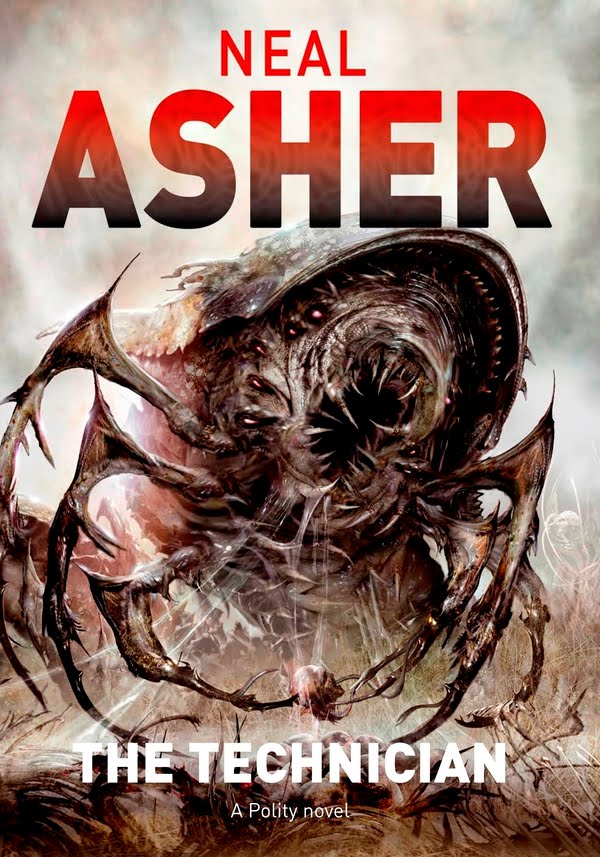
Now, noting one reaction to the links I included for The Technician, here’s the Amazon link for Brass Man, and here’s the Book Depository one (free shipping to the US).

Congruence.

You know I got this really odd feeling whilst I watched the film Lemony Snicket (which came out in 2004) upon viewing the scene with the leeches. My initial reaction was, did the film-makers read The Skinner, which was published in 2002? I mean, the boat, the sea, water you just can’t swim in, carnivorous leeches? Well, no, because the book in A Series of Unfortunate Events that has the leeches in it, called The Wide Window, was published in 2000. The congruence of some ideas amidst writers can sometimes be quite astounding, and I think it all comes about because though people might be writing something they think of as new, they are all always standing on the shoulders of giants (especially in SFF), who are the source of their inspiration.

Recently, whilst sitting down to watch the fourth season of Primeval, I realized I’d missed Season Three so bought a box set of One, Two & Three. I didn’t know what Season Three was about but, catching a hint of the storyline (not sure where) I looked up a review of it and got a feeling similar to that I experienced while watching the leech scene in Lemony Snicket:

…you can really see where most of the budget of the series went as Conner, Danny and Abby jump from anomaly to anomaly following Helen through a series of times, encountering creatures and dinosaurs in each time period they visit…

Eventually tracking Helen down, the team confronts her and finds out that her plan is a lot more insane than first thought. Having figured out what the artefact is and what it does (it’s a sort of future hard drive for anomalies), it’s then revealed that it can be used to go back to a specific point in time, namely 333 (a specific code used by archaeologists when describing the first ‘dig’ where hominids – or proto-humans – were found). The team find that it’s Helen’s intent to go back to the site in Rift Valley and poison the first settlement of hominids, which would mean that humans would not evolve and as such never exist.

Did the writers of Primeval read Cowl? If they were into time-travel it would have been an good choice since there aren’t many modern time-travel books out there and it was shortlisted for the PKD Award.

But no, I think not. It’s that congruence again showing us that there’s nothing new under the sun. The idea in Primeval was just putting a spin on and ramping up of the idea implicit in the time-travel paradox of, ‘What happen if I go back in time and shoot my grandfather?’ which is what I did in Cowl. Though I must admit the future monster on this car could (at a big stretch) be Cowl himself!

The Departure Cover.

Here is the cover of The Departure along with a couple of blurbs:

Like Wellsian war machines the shepherds stride into riots to grab up the ringleaders and drag them off to Inspectorate HQ for adjustment, unless they are in shredding mode, in which case their captives visit community digesters, or rather whatever of them has not been washed down the street drains.


Pain inducers are used for adjustment, and soon the Committee will have the power to edit human minds, but not yet, twelve billion human beings need to die before Earth can be stabilized, but by turning large portions of Earth into concentration camps this is achievable, especially when the Argus satellite laser network comes fully online…

Alan Saul has taken a different route to disposal, waking as he does inside a crate on the conveyor into the Calais incinerator. How he got there he does not know, but he does remember the pain and the face of his interrogator. Janus speaks to Saul through the hardware implanted in his skull, sketching the nightmare world for him. And Saul decides to bring it all crashing down…

There are no more wars, just police actions, though sometimes the truncheon used weighs in at about a kilotonne and the undertakers have to wear hazmat suits. Nobody goes hungry, so there certainly aren’t any food riots – just ‘dissident actions’ which end abruptly when the Inspectorate reduces the crowd to a writhing screaming mess using pain inducers.


And didn’t Chairman Alessandro Messina himself say that we are more free than ever before; community political officers conducted a survey only last year to prove this point. The Press has greater freedom too, now being government run and unburdened by financial concerns. People don’t disappear, see, they always come back from Inspectorate cells, ready to sing the praises of the Committee.

But Alan Saul knows that twelve billion are due to die, that the Committee has decided the Safe Departure clinics, the ‘sectoring’ of zero asset communities, the reader guns, razor birds and nightmarish shepherds will not be enough. The Argus satellite laser network is their answer, and he intends to take it away from them.

Who Reads My Books: Andy Plumbly

Andy Plumbly / Fader 209

Hey, my name is Andy and I’m a geek. I’m 26 and living in Norwich where I have been since forever. Reading sci-fi books, watching sci-fi movies and playing games takes up most of my free time when I’m not doing arty bits and pieces or writing.

Which leads me to when I first contacted Neal years back with a picture I did of some Frogwhelks after being inspired greatly by The Skinner. The lines were wobbly and it was a cartoon design but Neal kindly put it up on his blog and Myspace page which made me super happy.

Art and design was more of a hobby back then but over the years (after gradually gaining more skills & confidence) I realised I wanted to go into art and design as a job.

So here I am, trying to start up as an artist/graphic designer! It’s tough finding work (as it is in general for all unemployed at the moment) but I’m building up a portfolio in this spare time and doing work for free if friends need something done.

As mentioned at the beginning of this I would consider myself to be a geek. Been gaming since I was 3 when I first played Pac-Man on the Atari 2600. Chewing on the controller was also fun.

I have recently bought Pac-Man Championship Edition DX on the 360.…so yeah, full circle.

Chewing on the controller still sometimes happens.

Pics of my face, bookshelf and arty stuff included for your visual digestion!

Andy