Okay, here’s the second part.
Category: Articles
Neal Asher Video Clip 17/2/11 Part One
On Writing: The Contents File
Every so often I will take a look at the work of writers who want to get their feet on the first rungs of the ladder leading to publication. But first let me make a distinction here. These are not wannabe writers since they are actually writing. They are not those who say, ‘I always wanted to write a book about so-and-so,’ to which the reply must always be, ‘Then why aren’t you writing it?’
Sometimes those who contact me are those in love with being a writer more than writing itself, though that is no barrier, just so long as they actually do write. Sometimes they are those trying to learn the secret handshakes and arcane rituals that will lead to publication. There aren’t any – you have to be stubborn, persistent, prepared to learn and take a lot of knocks, and in the end you have to write something a publisher thinks will make money.
I will look at a sample of the work these people produce if I am not right in the middle of something, if I happen to feel so inclined, if they are not rude and pushy and if I get some sense that they’re actually looking for advice, rather than praise. Sometimes I get that last one wrong, tear someone’s work apart, and know by the affronted response that they have learned nothing.
So what am I waffling about here? Having recently taken a look at someone’s work (Hi Khaled) and tried to ape the Peter Lavery scary pencil with a red pen, I thought it might be a good idea to start doing some posts here on what I see as the nuts-and-bolts of writing. As and when something occurs to me on that subject I’ll do a post here under the label ‘Writing’ to slowly build up what I hope will be a useful resource.
Today I’ll ramble on about a contents file:
A book is a large chunk of text. Now I know I’m stating the obvious but how, unless you have an eidetic memory, do you keep track of it all? Here’s my method. Generally my books are about twenty chapters long, each chapter broken into sections that can be just one or as many as six pages long. Each of these sections is written from the point of view of just one character. Let me digress for a moment:
To my mind a common mistake I see is the switching of POVs sometimes from one paragraph to the next. This is confusing for the reader. It can also cause the reader to fail to engage with the characters.
Continuing… I keep track of a book by first bookmarking each of my chapters as I write them. After I’ve written a couple, I then open another file with the pages (usually about two) switched to two-column mode. In the case of Gridlinked, for example, this file is called ‘gridcontents’. In this I list the chapter number followed by a very short description of each section in that chapter. If required I’ll add timings. This is useful for keeping track but it’s also handy because I am writing down what happens in each section. If I can’t sum up ‘what happens’ this probably means I’m waffling and the section might be better cut, or the useful elements of it distributed elsewhere. Here’s a sample from ‘orbuscontents’:
Chapter 7.
U-space Missiles
Vrell hunts mutations.
Prador kamikazi
Orbus to hunt Vrell
Golgoloth to Oberon
Jain starts to wake
There’s something further to add here. As many of you know, I don’t particularly do a lot of planning before writing a book, so I don’t produce a summary or synopsis beforehand. However, after I’ve handed the book in and as it heads towards publication, my publisher wants to get people interested and give them some idea of what it’s all about. At this point, with the book finished, the contents sheet comes in useful for writing the synopses. I copy the contents sheet, get rid of column mode, then work through turning each short description into a paragraph or so. Next I take that and begin melding it; losing some of the straight-line chronology to focus on the story, on what it is all about. This usually results in about six pages of single-spaced text. After that I’ll make a couple of abstracts – one at about half the length and one summing it all up on a page.
The art of précis is well worth learning.
Here endeth today’s lesson.
International Space Station.
German Prador Moon
Had Enough
Here is an excellent letter to an MP from someone who is rather disgruntled with the present state of affairs in this country. I thoroughly agree. It is, of course, the case that he is lucky to even be able to opt out. Most people are firmly nailed to the treadmill of debt, high taxes and a political class that delights in butt-fucking them at every opportunity:
We have both chucked our jobs. I made three people redundant and myself and my wife will no longer be paying taxes at anywhere near the rate we did before. We will both be seeking part time jobs and don’t really care about the salary levels.
Why would two professional people like us both dump our professions, the very things that as young adults we strove to achieve?
Simple. It just isn’t worth the effort anymore in a world where a significant minority leech off of the rest of us and where the government spends over 50% of what we earn and takes that money on pain of imprisonment…
Singularity Stuff.
Thanks to David Regan for sending me a link to this article about the ‘singularity’. I agree with a lot of what is being said here, like, for example, that technological development is exponential and that Moore’s Law doesn’t just apply to the number of transistors on a microchip. However, this all smells of science-as-religion.
Don’t worry, look at these graphs, everything is going to get all better. Or, Jesus will return and sort everything out.
Our technology is also developing in all sorts of areas, whilst in others nothing has changed and in some cases things are regressing. Yes, we have nuclear reactors and fusion cannot be so far in the future, but all around me people are building fucking windmills. Yes, we can create high-producing GM crops, we have powerful specific insecticides and herbicides and machines that can do the work of hundreds of farm workers of a previous age, whilst lunatics are advocating organic farming that couldn’t feed more than a third of the population we presently have. Yes, we have every kind of contraception possible, even long-lasting implants, but the world population is still heading for seven billion. Yes, we are coming to understand what happened in first few seconds of the big bang, but billions on this planet think some beardy fella in the sky is in charge.
I shan’t belabour the point.
Yes, technological development is fast, but the impact of it is subverted by politics, by religion, and it is undermined by fear and subjected to the drag of human stupidity.
All that being said, I found this very interesting:
For example, it’s well known that one cause of the physical degeneration associated with aging involves telomeres, which are segments of DNA found at the ends of chromosomes. Every time a cell divides, its telomeres get shorter, and once a cell runs out of telomeres, it can’t reproduce anymore and dies. But there’s an enzyme called telomerase that reverses this process; it’s one of the reasons cancer cells live so long. So why not treat regular non-cancerous cells with telomerase? In November, researchers at Harvard Medical School announced in Nature that they had done just that. They administered telomerase to a group of mice suffering from age-related degeneration. The damage went away. The mice didn’t just get better; they got younger.
Listening to The Skinner.
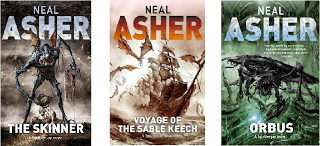
I have just a few chapters more to listen to of The Skinner audio book. It’s been an interesting and enjoyable experience. I wasn’t entirely sure about the precise old man’s voice Gaminara used for Sable Keech but it’s grown on me and I now think it’s the best of all. I noticed how when Captain Ron first appeared, his first words were flat but, directly after the description of him, Gaminara turned him into a Glaswegian, which made me laugh out loud. Other highlights are the South African Batian mercenaries, a Welsh Golem and a slightly crazy Irish Olian Tay. Of course what he is doing here is trying to make them distinct beyond the ‘he said, she said and it said’ and, in the end, how does a centuries-old hooper speak, or a walking corpse, or a lobster-shaped war drone?
Throughout the reading I’ve picked up on a few mistakes e.g. the first reference to the ‘Spatterjay viral form A1’ came up as ‘AI’, but only once and understandable in the context. More noticeable to me is how by listening to the book I’m hearing more of my mistakes. In the later chapters, when Sable Keech, Boris, Roach and SM13 are limping across the sea on Keech’s AG scooter I’ve written ‘the probe SM13’ rather than the ‘drone’.
Noticeable too has been just how much I remember – knowing precisely what’s coming as each section starts. I also wish there had been a further beat in the breaks between sections.
I’ve also been picking up a lot on where the writing obviously doesn’t flow well enough – often where it’s too abrupt and staccato. I did wonder too if the change in my writing over the years is reflected in the reading time of the books. My copies of them list The Skinner at 16 hours 2 minutes, The Voyage of the Sable Keech at 16 hours 46 minutes and Orbus at 14 hours 45 minutes. Word counts respectively are 149,879, 158,775 & 135,525, which again respectively give word rates per minute of 156, 158 & 153. Um, no definite trend there. Maybe the lower figure for Orbus is simply due to the tense change?
All of this also brings home to me something I read in one of the numerous ‘How To’ writing books I’ve gone through: reading out your writing is a good idea, because if it doesn’t flow easily off the tongue then it isn’t flowing easily off the page into the reader’s brain. I must start doing a bit more of this reading out loud myself.
Gaiman on Copyright Piracy and the Web
I picked up this Neil Gaiman clip via an SF Signal twitter. Rather similar to an earlier speculation of mine that book piracy might be an electronic version of the second-hand book shop. I’m not entirely sure I agree. Does this apply outside SF? How does it apply for lesser known authors? How does it apply to authors who aren’t regularly publishing books?