Article 18: Who Threw That?

  Here’s an article I wrote quite some years ago. I probably did it at around about the time films like Armageddon were doing the rounds since it seem likely the reporter or the news story concerned was looking for something ‘topical’.

WHO THREW THAT?

So, on February the 1st 2019 there is a chance, cosmically speaking, of a large lump of rock slamming into Earth. According to ‘expert opinion’, so the media told us on the morning of this announcement, this thing is a mile and half wide and will impact with enough force to wipe out a country the size of Britain. This was then upgraded, within an hour, to be one capable of wiping out the USA – a change I put down to both media hype and a dearth of information. Of course experts will vie with each other to predict greater and greater disasters to get themselves on television, so you can expect by the time you read this that the asteroid will destroy all life on Earth. But then maybe it could. What happens if it hits the oilfields, what changes might it make to the weather, might it perturb Earth’s orbit enough to sling us into an ice age or turn everything to desert? I’m not an expert, so I can’t really say. At present, measurements are not yet accurate enough to tell us precisely what will happen. The asteroid will probably miss us completely and go round for another try in ex-thousand years time. What is certain is that measurements will become more and more accurate as the asteroid draws closer. Personally, I hope that they show, in the near future, that the asteroid is certain to impact. This is not because I am a nihilist, but because such a state of affairs would impel the kind of hard technological advances not seen since the World Wars. We have the time and ability to stop this thing, but we would have to get off our arses to do so. Such a threat could pump huge amounts of cash, heretofore blown on military spending and idiot bureaucracy, into giving us a firmer foothold in space. Resultant developments would be hugely beneficial and solid – we would not be able to afford the dipstick mistakes that have wasted the last few Mars’ missions – and I can see that how once the rock is blown off course there’ll be no turning back. Suddenly we’ll be dwellers in a huge and hostile universe, not post-Copernican Earthlings. And even those grandads saying, “Well, we didn’t have those new-fangled asteroid thingies in my day,” will have to sit up and take notice. For the SF writer there are other situations to extrapolate. Taking the phrase ‘capable of wiping-out the USA’ it is almost inevitable that the Bin Ladens of this world will say that it has been sent to do just that. Let me predict that they’ll name the asteroid ‘The Fist of God’, and that fundamentalist terrorists will do everything they can to sabotage any project to change its course. Because there will be no guarantee that the project will be successful, a more careless attitude to life and liberty might prevail. Maybe the Western World would take this opportunity, in the purported interests of humanity, to flatten the Middle East and take control of the oil. Don’t doubt this possibility. It’s worth being reminded that the firepower of a couple of nuclear submarines could do the job. Have people already forgotten what atomic bombs can do, and more specifically, neutron bombs? Perhaps Pakistan and India will take this opportunity to settle their differences – end-of-the-world scenarios being an excuse for all sorts of mayhem. Will China just sit back and watch all this? And, there is always the most unlikely possibility: this could be a unifying influence on the entire planet. Taking an even larger and more tongue-in-cheek view, one might even wonder about the timing. Consider how fortunate we were to have a moon that strips away atmosphere thus preventing this planet going catastrophically greenhouse and ending up like Venus – a moon that also gives tides so that life developing in the water will certainly also end up on land. Previous impacts wiped out life forms that would not have led to us. The asteroid that drove the dinosaurs extinct ended the 160 million-year reign of creatures that showed no signs of growing brains larger than peanuts. Aptly-timed ice ages then led to the survival of creatures with an interest in banging rocks together. A hundred years ago we would have been unable to do anything about the approaching cataclysm, moreover, probably would not even have detected it. This is all obviously the determinist 20/20 hindsight of the bible-thumping trench survivor: “God loves me, that’s why the shrapnel took the top off of Harry’s head and not mine.” But it’s just as obvious that the aliens sent this rock, and that we have seventeen years in which to prove ourselves fit to join the galactic community.
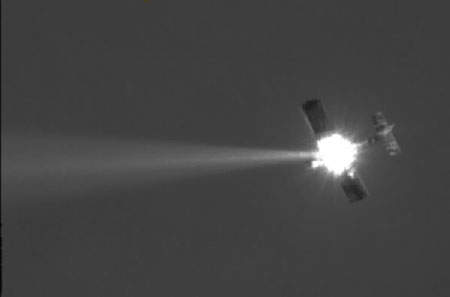
Science Fiction Laser Beam Nonsense!


This was passed onto me from my brother Bob. It’s on Tom’s Guide.

In September, we reported that Boeing successfully defeated a ground target using its Advanced Tactical Laser aircraft. Now the company has shown its laser prowess again by tracking and destroying small, unmanned aerial vehicles in the air. A single laser beam, fired by the U.S. Air Force-sponsored Mobile Active Targeting Resource for Integrated eXperiments (MATRIX), shot down five UAVs at various ranges.

Squids in space next maybe?

Water on the Moon.

Remember NASA dropping spacecraft on the moon with the intent of analysing the dust plume created? It was all very disappointing for those accustomed to Hollywood CGI mega-bangs and received a fair bit of ridicule in the papers. Well, it was an experiment whose importance and results is immediately apparent to anyone like me, and readers here.

A small NASA spacecraft and its companion rocket did indeed strike water when they slammed into a permanently shadowed crater at the moon’s south pole, NASA announced November 13.

Water available on the moon means the possibility of a base like the one depicted in that old series Space 1999. And we’re not talking about a bit of damp here:

But analyses since then reveal that the impact kicked up at least 100 kilograms of water vapor and ice, or 25 gallons. LCROSS project scientist Anthony Colaprete of the NASA Ames Research Center in Mountain View, Calif., reported the finding during a briefing at Ames.

Go read the whole article at Science News.

Friday 13th

Well, Friday 13th this year has lived up to its reputation. All through the day the weather was grey, miserable, pissing down and then, in the afternoon, a knock at the door. Our next door nieghbour Heidi was stopping off to tell us that she’s had her cat, Basil, put down. This is the cat who, the moment he moved in next door, clambered over into our garden and came to say hello. Thereafter his visits were constant; every morning we’d find him waiting at the back door. So, coming back from Crete on the 10th we were looking forward to seeing various people, and him. We did see him, but he was a bit slower, looked a bit older. Little did we know we were going to see him for such a short time. He had pancreatic cancer that had also spread through his body – no real escape from that one, I know since it was what got my father. Damn, bugger and fuck, which is probably a mere fraction of what Heidi is feeling now.

Letters to Athens News

Here’s some I’ve letters sent to Athens News, a paper in English focusing mainly on Greek news:

Dear Sir,

A previous writer to this paper expressed disappointment at the ‘windows’ in the coming smoking ban here in Greece. This person was apparently looking forward ‘with bated breath’ to the time when he or she could go into a taverna, bar or club without the result of ‘stinging eyes, my clothes and hair stinking and the air suffocating me’. I have to say I read and heard much of the same sort of hysterical nonsense prior to the British smoking ban: many non-smokers shouting about their ‘right’ not to have these dirty, evil smokers inflicted upon them. These vocal anti-smokers also happily repeated the propaganda of the government and organizations it funds, like ASH, which stated that there would be no loss of trade to pubs and clubs because the smokers leaving such establishments would be replaced the non-smokers flocking back. However, we see the true results of the British ban now.

Prior to that ban, in 2007, the rate of pub closure across Britain was four every week. After the ban it rose to twenty-seven every week as all those belligerent anti-smokers failed to return to the pubs. Many bingo halls and working men’s clubs have also gone to the wall, and tens of thousands of those previously employed in all such places lost their jobs. Many pubs even lost non-smoker customers because they didn’t want to go to places now empty of their smoker friends. For those who have hung on we even have the ridiculous situation of non-smokers following smokers outside so they will still have someone to talk to. And perhaps they are right to go outside because, as many discovered, the smells from the toilets and the stale beer are now no longer disguised by the smell of cigarette smoke.

Outside, of course, they might also spot the owner of the pub who, having paid hundreds of thousands for the place, now cannot smoke a cigarette on his own premises. Such blanket bans are totalitarian – the bar owners should be the ones to decide whether or not they will allow smoking. The justification, of course, is ‘health’ and the lies about passive smoking. The reality is that only politicized ‘science’ came up with any figures on passive smoking and, as has already been proven by bans elsewhere, they in no way reduce the number of smokers. And those inflicting such bans are utterly two-faced, as we know by the smoking room at the London G7 Conference, and the failure to enforce non-smoking in the European Parliament.

The smoking ban in Britain was an unmitigated disaster for the pub trade and, if enforced in the same way here, it will kill tavernas, clubs, kafenions and restaurants. No arguments: people will go out of business, jobs will be lost, the government will lose revenue and more freedom will be destroyed by an autocratic state.

Sincerely

Neal Asher

Crete.

Dear Sir,

A blossom from a hot pink bourgainvilla blew in through the front window and settled in my lap. It was dried out like ricepaper and it almost seemed to me that Crete was saying, “Sorry, this is the only consolation I have to offer.” Before considering that this might be a keepsake – something as insubstantial to remember this restaurant by as the promise of a politician – I ground it to dust on the tablecloth. None of the owners or waiters saw or complained, since they were sitting at one of the few outside tables smoking cigarettes they weren’t allowed to smoke on their own property.

Yes, the smoking ban has arrived in Greece, and the bansturbators have won another battle for totalitarianism. I wrote a letter to this paper before about it and there they were, whingeing about their clothes smelling of cigarette smoke after they’ve been in a bar, totally ignoring the point that in many cases their choice is likely to be a bar that allows smoking or no bar at all.
So, there you have it: until such a time as I see ashtrays back on the tables of this restaurant I have enjoyed for a couple of years, I won’t be eating there. It’s a shame but what can I do? Just as so many pub owners (or rather, erstwhile pub owners) have discovered in Britain, a lot of people don’t protest loudly enough, but given the opportunity always vote with their feet.
I wish I was living in a British or a Greek democracy but, really, in Europe democracy drew its last terminal-smoker asthmatic breath about twenty years ago as the EU project built up momentum.

Understand this, Cretans, in five years time there will be no smoking licences and there will be no exceptions, and the bansturbators will be after your raki next. Do you for one moment think all those stills, all that unregistered, unmonitored and most importantly, untaxed fun is in any way part of the EU plan?

Sincerely,

Neal Asher

Update from Crete.

Okay, it’s been a while since I’ve blogged here what with being on the island of Crete right now with no Internet connection here in our house, the Internet café in Sitia now a clothing shop selling expensive looking men’s jackets whilst another connection in the Status Bar in Makrigialos was just not functioning at all – a statement that also covers the condition of my brain about an hour or so later after our third carafe of white wine.

Having entered our house here to be greated with mud on the floors, water stains down a couple of walls, a strange furry object in the washing machine that might have been a flannel or a sock in a previous life, and a proliferation of mould elsewhere, things were pretty depressing at first. But, with a bit of clearing up, the Cretan sunshine kicking in, the garden dug, planted and already showing sprouts of rocket, things are gradually improving. In the intervening time I’ve taken the latest book up past 130,000 words and am on the home straight. I just need to research some stuff on the Internet, like Mars, like the effects of CO2 poisoning…

Since the only television here is obviously Greek, with maybe on English film or episode of some series each night interspersed with adverts that go on for long enough for you to not only make tea but make a sandwich, clean the windows and polish the cutlery, whilst forgetting what it was you were watching, I’ve also gone through a few books. These include three of which were each a firm index finger at political correctness and New Labour, being Littlejohn’s Britain and two by Jeremy Clarkeson: I know You got Soul and Born to be Riled.

The first of these wasn’t that great – far too many made-up songs or scripts that weren’t that funny and, frankly, enough about the insane way Britain is being run to just leave you angry. The first Clarkeson was enjoyable, what with him going on about his favourite machines, but didn’t have quite so much of his laugh-out-loud moments as The World According to Clarkeson. The second had those moments but since these were Top Gear articles in the main, they went on to stuff about 0 to 60, bhp and the like, and I started to lose the will to live. Some science fiction next, I think.

SF Taboo.

Asked the question on Mind Meld:

Once upon a time, sf/f was full of taboos: no swearing, no sex, etc. We’re thankfully past those days, but are there any taboos still remaining or new ones that have sprung up? Have you ever had trouble with publishing something, or caught yourself self-censoring?

I found myself at a bit of a loss but, came up with this answer:

Well, every writer has had trouble getting stuff published, but probably because they breached the publishing world taboo of writing crap. For me, beyond 2000 when I was taken on by Macmillan, I’ve been censored all the time in that respect – it’s called editing. But no, I don’t really have much trouble getting stuff published and I don’t self censor … except all the time in regard to that first publishing taboo. Doubtless, in years to come some minority group lobby will run out of larger targets and focus its attention on SF books, and then violence, drinking, smoking and excessive consumption of beefburgers will be a no no. I just hope I’m in a position to give them the finger by then.

Other writers and those commenting have produced other answers over here. Some people might even find all this interesting. I have to add that I do self censor here — in fact I did it in the last sentence.

Life in the 1500s.

I wonder how much of this is apocryphal:

The next time you are washing your hands and complain because the water temperature isn’t just how you like it, think about how things used to be. Here are some facts about the 1500’s:

Most people got married in June because they took their yearly bath in May, and still smelled pretty good by June. However, they were starting to smell, so brides carried a bouquet of flowers to hide the body odor. Hence the custom today of carrying a bouquet when getting married.

Baths consisted of a big tub filled with hot water. The man of the house had the privilege of the nice clean water, then all the other sons and men, then the women and finally the children. Last of all the babies. By then the water was so dirty you could actually lose someone in it. Hence the saying, ‘Don’t throw the baby out with the Bath water.’

Houses had thatched roofs-thick straw-piled high, with no wood underneath. It was the only place for animals to get warm, so all the cats and other small animals (mice, bugs) lived in the roof. When it rained it became slippery and sometimes the animals would slip and fall off the roof. Hence the saying, ‘It’s raining cats and dogs.’

There was nothing to stop things from falling into the house. This posed a real problem in the bedroom where bugs and other droppings could mess up your nice clean bed. Hence, a bed with big posts and a sheet hung over the top afforded some protection. That’s how canopy beds came into existence.

The floor was dirt. Only the wealthy had something other than dirt. Hence the saying, ‘Dirt poor’.

The wealthy had slate floors that would get slippery in the winter when wet, so they spread thresh (straw) on floor to help keep their footing. As the winter wore on, they added more thresh until, when you opened the door, it would all start slipping outside. A piece of wood was placed across the lower part of the doorway. Hence, ‘a thresh hold’.

(Getting quite an education, aren’t you?)

In those old days, they cooked in the kitchen with a big kettle that always hung over the fire. Every day they lit the fire and added things to the pot. They ate mostly vegetables and did not get much meat. They would eat the stew for dinner, leaving leftovers in the pot to get cold overnight and then start over the next day. Sometimes stew had food in it that had been there for quite a while. Hence the rhyme, ‘Peas porridge hot, peas porridge cold, peas porridge in the pot nine days old’.

Sometimes they could obtain pork, which made them feel quite special. When visitors came over, they would hang up their bacon to show off. It was a sign of wealth that a man could, ‘bring home the bacon’. They would cut off a little to share with guests and would all sit around and ‘chew the fat’.

Those with money had plates made of pewter. Food with high acid content caused some of the lead to leach onto the food, causing lead poisoning death. This happened most often with tomatoes, so for the next 400 years or so, tomatoes were considered poisonous.

Bread was divided according to status. Workers got the burnt bottom of the loaf, the family got the middle, and guests got the top, or the ‘upper crust’.

Lead cups were used to drink ale or whisky. The combination would sometimes knock the imbibers out for a couple of days. Someone walking along the road would take them for dead and prepare them for burial. They were laid out on the kitchen table for a couple of days and the family would gather around and eat and drink and wait and see if they would wake up. Hence the custom of holding a wake.

England is old and small and the local folks started running out of places to bury people. So they would dig up coffins and would take the bones to a bone-house, and reuse the grave. When reopening these coffins, 1 out of 25 coffins were found to have scratch marks on the inside and they realized they had been burying people alive. So they would tie a string on the wrist of the corpse, lead it through the coffin and up through the ground and tie it to a bell. Someone would have to sit out in the graveyard all night (the …graveyard shift.) to listen for the bell; thus, someone could be ‘saved by the bel, or was considered a ‘dead ringer’.

And that’s the truth…Now, whoever said History was boring?

Alcohol Units

You know, I’d really like to cut down on my drinking, but I’ve been having a few problems lately. I blame television. Every evening I keep seeing this government sponsored advert for booze. It displays nice frothy pints of beer all ready to guzzle, it shows a lovely glass of chilled white wine, the glass all dewy and its contents utterly tempting. I’m not entirely sure what the numbers written into the dew on the glasses is all about, but never mind. There is a health warning near the end of this wonderfully alluring display of alcohol, but by then it’s too late because I’ve already cracked open a bottle.