To continue my video learning curve I’d like more questions from you all. Try to avoid repeating the ones you’ll find here and try to be specific. Any “How do you write a book?” questions will be answered with “A keyboard” and “How do you be a successful writer?” with “I sell books.” I don’t mind answering stuff outside of my SF, but I’m not going to get political … or too political.
Author: Neal Asher
Shadow of the Scorpion – New Cover.
Well, Jon Sullivan has now produced another new cover, this time for Shadow of the Scorpion. If you want to check out any more of his art, which is bloody cool, go to jonsullivanart here.

Failed Genetic Rackslub
Here’s a couple of pictures from our very own Vaudeviewgalor Randisraisins (I wish you’d shorten that name, Vaude) which are, I quote, ‘ just did a title page for a paranormal easter bbq book coming out 2010. sending the attachment and an illos for a jack vance game’.

Not quite sure what a paranormal barbecue is … kebabs with ectoplasm sauce? But certainly the name Jack Vance interest me.

Incidentally the title of this post comes from the subject line of the email. I suspect there’s a strange hidden society blossoming somewhere in Berkeley, but I guess that’s not unusual for California.
Neal Asher Video Clip 1/12/09
Little Bit More Orbus
Here over at Rick Kleffel’s Agony Column is an interesting review/column:
Oh how we love our monsters, as does Asher. More importantly, he knows how to put them to work in a novel, in this case, ‘Orbus,’ where the main character, the title character is a creature that most normal humans would say is utterly monstrous. But he’s just the tip of the iceberg here. What Asher excels at is giving readers sympathetic monsters, giving us the comic relief characters who are AI “subminds,” sprouting tentacles and spewing bile. These are the “good guys” in Asher’s universe. And the good are just as grotesque and deformed as the bad; sometimes they’re also as bad as the bad. Situational ethics have permeated the fabric of Asher’s Polity universe.
And here at concatentation:
Is this Asher’s best book? Not from a question of plot, characterisation, and action? But more importantly, from the viewpoint of the writing itself, and his control over his own labours. Maybe he just keeps getting better which makes you wonder what his next book might be like, because Orbus is a cracker from start to finish.
Thank you very much.
Reader Alert!
Just to let you all know that, for reasons all to do with the mysterious and deeply arcane arts of publishing, The Departure will be published after the one I’m presently writing: Gabbleducks. I also need to add that for reasons of clarity (I’ve already published The Gabble which is too similar a title) and other reasons entirely my own (because the story has taken some seriously odd turns) Gabbleducks will have to remain a provisional title for now. It might end up being called The Technician, The Ballad of Jeremiah Tombs, Sculptures of Bone or even Alien Resurrection (Hur Hur). I just don’t know right now.
Update (because of Mark Chitty’s comment): There will be a book next year – I just have to work harder on the one I’m presently writing so it’s ready for then. The two titles will simply be swapping places in the publishing schedule.
Competition Winnners!
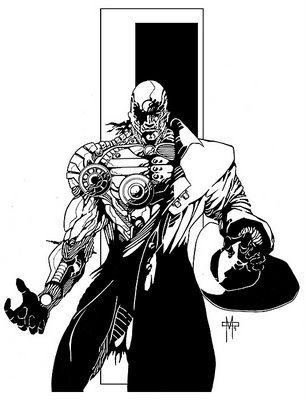
Okay, after much consideration of the various Mr Crane images I have to give special mention to Ivan Halen and Bob Lock, but the winner is this one by Carlos Mendez, who gets first prize.
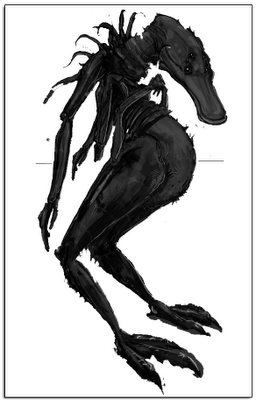
The runners up are Vaudeviewgalor Randisraisins (try saying that without taking a breath) for his psychedelic glister, which touches on the fact that if you eat glister brains it makes you high, and Robert McGregor for his gabbleduck. Regarding the latter: this is not really the image in my head but, if I’d seen it before I’d started writing about gabbleducks, it would have been.

 So, now I have to get the prizes to the various winners. Please, if any of you three are reading this, email me with your addresses at ndotasheratvirgindotnet.
Video Clip
Well, I did my first video clip a few posts ago and have been thinking on what to do next. Just prior to this I’ve posted an interview from Death Ray Magazine. Interviews generally demonstrate the interest of the interviewer (if any) and what he thinks might interest his audience, and he won’t necessarily get that right. So, why don’t we dispense with the interviewer sitting between me and you? YOU ask me questions. Put them here in the comments section and once I’ve compiled enough I’ll do another video clip to answer them, if I can, if they’re not to personal or abusive!
Death Ray Interview
Being as Deathray seems on the skids, I thought I’d post their interview with me here. I’ve a whole collection of interviews which I intend, gradually, to post here. The first question here relates to one of my stories published in their magazine.
Death Ray Magazine Interview.
Neal Asher Questions:
First tell us why you have chosen the story you have.
Neal: It’s the first gabbleduck story I had published in which I start to look more closely at the weirdness of them, and I like it.
Do you think that your Polity is a relatively accurate in its depiction of the relationships between men and machines, or is it just a heap-load of fun?
Neal: In the context of the Polity I try to suspend the reader’s disbelief as best I can but, frankly, if an accurate depiction of the relationship between man and machine was boring I’d drop it like scorpion sandwich. Always, with me, entertainment first. That being said I do think we will develop artificial intelligence and still be questioning what the Hell it is (hence the odd reference in my books to the X-hundreds of revisions of the Turing test); we will be attaching up our wetware to hardware and probably, in years to come, be walking about with memory extensions, increased processing and modems inside our heads. Perhaps a more likely scenario than the machines taking over is that the lines will become so blurred we’ll be almost indistinguishable from them.
It’s mentioned on your website and in a number of other places that you’ve tried writing fantasy on a few occasions. Is this still a genre you’d like to get into?
Neal: All those years ago, when I made the decision to pursue this profession, my first aim was to write the good old fantasy trilogy, which I did, along with the first book of a second trilogy. At that point, despite having an agent for a short while, I remained unpublished but didn’t want to stop writing. I thought it pointless continuing with the second trilogy when the first had yet to be placed so turned elsewhere, first doing a contemporary novel (also sitting in my files) then to the British small presses where I got my first successes writing short SF. From that it was a natural progression to longer works, steadily growing success until taken on by Macmillan. I write SF because I enjoy it more now, and I’m known for it and it sells, but one day I will have a go at rewriting the fantasy books, mostly because they are just unfinished business.
Mason’s Rats is your other most published ‘universe’. What was the inspiration behind this? It’s like the Rats of NIMH done in a classic BBC1 comedy style…
Neal: They’re not really my ‘other most published’ since there’s only three short stories, but they seem to be stories a lot of people have enjoyed. The inspiration? I guess living in rural Essex and seeing the bureaucratic bullshit farmers have to put up with, and also thoughts on how human beings are now one of the largest evolutionary pressures on all other living creatures on this planet. What’s going to develop intelligence next, and when? And hey, rats with crossbows are cool.
It’s been said to me ‘Neal Asher gives good monster’. Do you agree?
Neal: Well, I hope so – I try. I like my monsters as much as many others do and whilst trying to make them fit properly into some alien ecology I like to also venture into that mythical territory occupied by snarks and jabberwocks. Monsters are fascinating and fun when they’re in a book or film, hence the success of such human monsters as Hannibal Lector and others like the H R Giger Alien. Even in the real world they remain fascinating, hence the interest in serial murderers and surfer-gobbling white sharks. Just not so much fun, though.
Cretan Raki.
From October to December the Cretans start producing raki. Just prior to this you’ll see pick-up trucks motoring around loaded with crates of grapes or big brown plastic barrels as preparations are made. Traditionally the stuff was supposed to be produced from whatever was left of the grapes after pressing for wine, but I saw none of that. The grapes were transported straight from the vine to the barrels, were mashed up and left to ferment with their natural yeasts. Anyone who knows anything about wine making will know that the largest quantity of alcohol is produced in the first few weeks of fermentation. All the time the wine spends in demijohns or barrels thereafter is just to improve the quality of the wine, and wine was not the aim here.
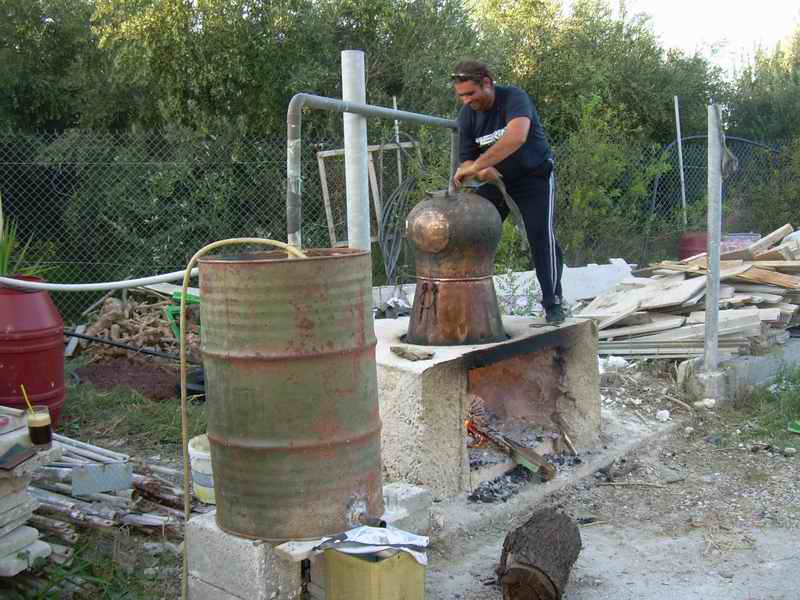
The fermented mash is then loaded into the raki still and distilled. The result, raki, is a bit like grappa and is not ouzo. What you get is pure alcohol (with a bit of water) rather like whisky before it’s spent time in a sherry barrel to give it extra flavour and colour.
This stuff is made all over the island, even small villages will sometimes have three or four different raki stills. Some is for personal consumption and some for sale. We can buy Ziros raki from from a garage just a few miles away. It costs 4.50 Euro for a litre and a half. I’ve visited the place often enough now that I just go round the back to the barrels and fill up my bottles myself. It is also frequently a gift, along with olive oil, when eating with Greeks. In kafenions you can buy a karavache of raki for 1.50 Euro, which gives you about five good shots. Along with this you’ll also get mezes (usually for free) – plates of usually seasonal food: cold cooked broad beans and segments of sweetcorn, olives (always), raw broad beans, pear and apple, peanuts, tomato and cucumber sprinkled with sea salt, artichoke hearts with lemon juice and salt, cooked ‘horta’ … the list is a long one.
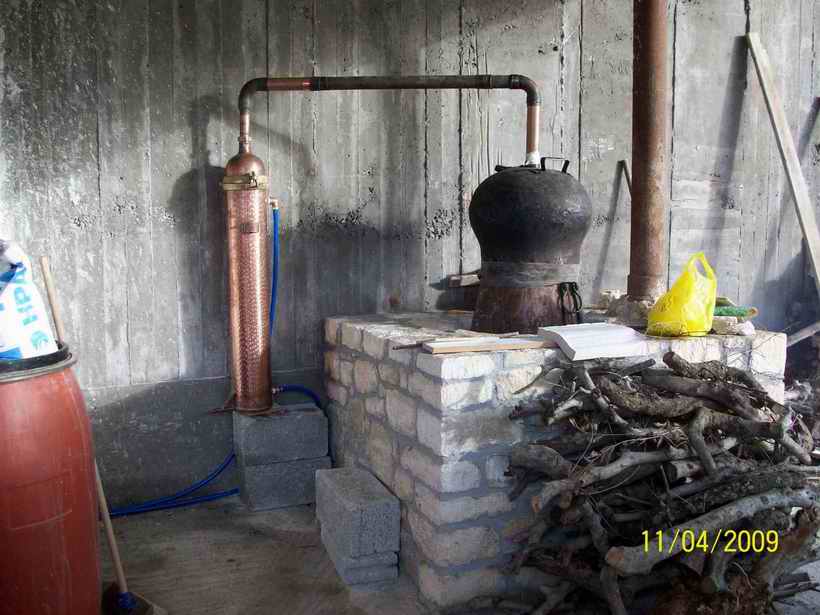
When the Cretans run a kazani (I’m still not sure what this name applies to: the still, the place where the still is located, or the party they have there) they usually fire it with olive wood. Since distilling sometimes hundreds of litres of raki takes some time they make an occasion of it. Guests are invited, raki glasses are never allowed to grow empty, and either on the fire or on a barbecue made with hot coals plenty of food is cooked – brisolas (marinated belly pork), baked potatoes, roast sweetcorn, chestnuts, sausage, rabbit, garlic bread – whilst other raw veg and fruit is also provided – pomegranites, cabbage with lemon juice and salt, artichoke hearts etc.
We’ve been fortunate enough to be invited to a number of these kazanis. The first picture is of the still at a Greek friends house (the guy standing there is Mikalis – excellent fellow). We’re also fortunate enough to have one of these stills located about thirty feet from our front door – a good staggering distance. The second picture is of that.