Update

Not much in the way of actual writing being done at the moment since I’m reading backwards through Jupiter War. I read one paragraph at a time working backwards through the book. This way I don’t get involved in the story and am more likely to pick up on mistakes (many of you reading this have of course read this before). Another thing this technique helps me pick up is repetitions and the boring bits – the latter are doubly emphasised because reading backwards through a typescript is boring enough in itself. I’ve been finding myself putting the words CUT THIS DOWN or THIN THIS OUT on a few occasions, in red ink, underlined.
I’m doing this with the printed typescript, marking in corrections as I go, then I’ll work through it again from the start as I make the corrections to the document on my computer. After that it’ll be time to send it in to Macmillan, followed either by a return to the Penny Royal thing or time spent writing up the synopses and blurbs for Jupiter War. I haven’t decided yet.
Today, however, even less work is being done, since we went to see Woman in Black. The John Carter movie we’ll save for next week – a film I’m a little dubious about having read this review from John C. Wright. What else? Oh yeah, I should be getting a phone call from the US publisher of the Owner series tomorrow night so I should be able to give you some more news on that anon. That’s all for now.  

It's the Population, Stupid.

There’s quite a bit on the news about a hose pipe ban in the East of England and I cannot help but note how the elephant in the room is being ignored (or, read The Departure).

Over just the last 20 years I’ve seen our local town of Maldon expand hugely, acquiring a suburban belt half a mile thick with its superstores, roads and other facilities. This is just one example of what has been happening across large swathes of this country yet, I don’t recollect hearing much about reservoirs being dug (though we do get nimby-ism resulting in this).  

We must also remember how people’s habits have changed since the middle of the last century when the weekly bath, shared by the family, was common. How many showers are pouring every day now, how many washing machines and dish washers churning, how many flush toilets operating? Consider how much water one person now uses each day, which can range from 50 to 150 litres, and multiply that by millions. And consider that the population of London alone is getting on for 8 million.
Another question to ask is where does the rain we do get go? With so much ground now covered with concrete and tarmac it runs off, into drains then into rivers and out to sea. This is also the cause of many of the floods the media have been getting hysterical about in recent years. You may see some old town or village getting submerged, but don’t just blame the weather, blame the housing estates and cities upstream preventing water soaking away and thus passing the buck downstream. Put a waterproof layer over the land and water runs off quickly and, surprise surprise, the land dries up.    
Yes, we have had a couple of dry winters, but they are not the main problem. The problem is infrastructure failing to keep up; infrastructure right at the limit where it fails under just a little extra strain. And of course, it’s the population, stupid.  

Zero Point

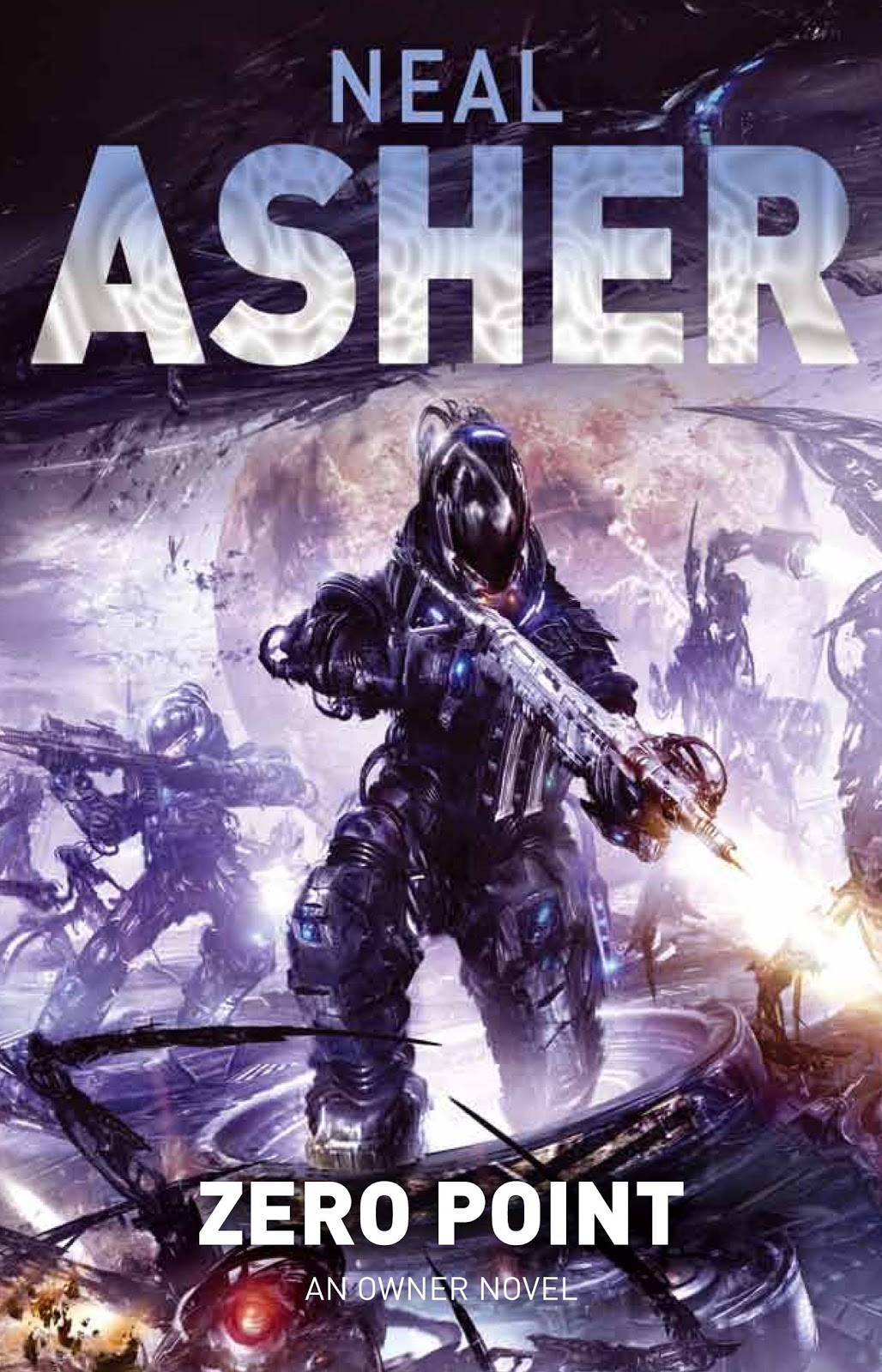
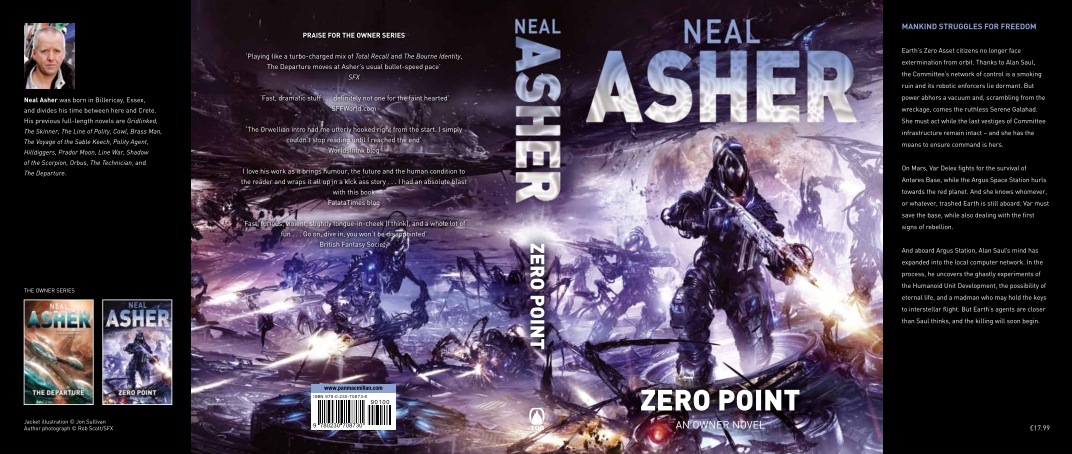
Here we go. Here’s the finished cover of Zero Point:

The billions of Zero Asset citizens of Earth are free from their sectors, free from the prospect of extermination from orbit, for Alan Saul has all but annihilated the Committee by dropping the Argus satellite laser network on it. The shepherds, spiderguns and razorbirds are somnolent, govnet is down and Inspectorate HQs are smoking craters. But power abhors a vacuum and, scrambling from the ruins, comes Serene Galahad. She must act before the remnants of Committee power are overrun by the masses. And she has the means.
Var Delex knows that Earth will eventually reach out to Antares Base and, because of her position under Chairman Messina, knows that the warship the Alexander is still available. An even more immediate problem is Argus Station hurtling towards the red planet, with whomever, or whatever trashed Earth still aboard. Var must maintain her grip on power and find a way for them all to survive.
As he firmly establishes his rule, Alan Saul delves into the secrets of Argus Station: the results of ghastly experiments in Humanoid Unit Development, a madman who may hold the keys to interstellar flight and research that might unlock eternity. But the agents of Earth are still determined to exact their vengeance, and the killing is not over…

PUBLISHED ON AUGUST 2ND.

Update

Okay, while in Chester I obviously didn’t keep up my word count and prior to that I was checking the final sheets of Zero Point so now, after ten working days of not doing any writing, I must get back into it. Yesterday I was still knackered. I could put that down to the unaccustomed walking we did but I suspect the heavy red wine consumption played its part too. This post, by the way, is me warming up my mental motor.
So where am I? The Penny Royal thing now stands at 77,604 words, at (about) chapter 10 of 20. I still haven’t reached the initial piece I wrote – it getting perpetually pushed ahead of the growing text that started out as back story and is turning into a book by itself. This, incidentally, is a meeting between one of the main characters and the drone Amistad. When I do reach this it will have to be completely revised, if not completely dumped (rather like the section I posted on the message board workshop, which I dropped when I redacted The Voyage of the Sable Keech). Now it’s time for me to reread the last chapter, insert another chapter break, and just get on.
What else? I’m sitting on a computer chair that keeps tipping over since, when leaning over to peer out the window yesterday, I managed to snap off one of the caster feet (I’ve ordered a new steel base for it through ebay, superglue having lasted about 5 seconds). My waffling about Mars has now appeared on SF Signal. I’ve finished my morning reading, which consisted of 14 science articles. I’m still waiting for a pdf or jpeg of the cover of Zero Point so I can post it here. And I’ve heard no more about the possibility of the whole Owner trilogy being published in America.
Right – to work.  

Chester

We took a train to Chester on Friday, neither Caroline nor I particularly liking driving there, and it was a quick and easy journey. Also, for no immediately apparent reason it was cheaper to travel by train there than it was to go to Brighton. Go figure. Here are a few photos of that city.

We went to see my brother Bob, sister-in-law Christine and their two daughters Samantha and Rebecca. Here’s Christine, Bob and Caroline.
Here’s the Waterstones I visited. On seeing that they only had four of my books there I wasn’t going to bother to ask if they wanted them signed, but relented. The girl working behind the counter then took a number of books out of a display alcove and put my signed copies up in it, along with my book marks, so it was worth it.
The whole break involved an awful lot a walking, which I’m still recovering from. I think my body went into a kind of shock after the first five miles, which could only be relieved later on by copious red wine. 

The Owner Trilogy

Well, no real announcement yet, but it appears the Owner trilogy – The Departure, Zero Point and Jupiter War – might be being taken on by an American publisher. If this does happen then all complaints about not being able to get hold of the ebook over there may well be resolved.

It’ll be interesting to see if the American reaction to this is as sharply divided. I suspect not, since the political left and right over there supposedly occupy a different position on the fallacious political scale to here. 
Righto, off to Chester today so it’ll be a quiet here. 
  

Mind Meld

On the website SF Signal they often have this thing called ‘Mind Meld’ whereby a question is asked and various characters from the SF world answer it. I’ve been asked for my take in a recent one in which the questions are: What is the appeal of the planet Mars in SF and fantasy? What is its appeal to you? I’ll let you know when that appears.
I knew I’d done this a few times but couldn’t remember how many so I went trawling through the SF Signal site in search of them. Here are three of my rambles: 
The Best Aliens in Science Fiction
For me the best has to be H R Giger’s creation…no I refuse to misuse the word eponymous…from the film of that name. In my time I’ve ranted about what I consider to be art and generally have seen very little I could call both art and truly original (Maybe that’s because I hadn’t see enough art, and certainly my view is changing now with what I’m seeing produced by the CGI crowd.), but way back in years of yore when I opened up a copy of Omni, turned over a page and saw my first H R Giger picture, I felt I was seeing something truly original and bloody good. I’m not sure if I even knew, when I went to see Alien, that Giger was the designer of both alien and weird sets, but I certainly knew afterwards. At that point I felt that the curse of the rubber head had died. The alien in that film and its sequels was not something you could laugh at – aliens had just grown up.
As for aliens in SF books, in them there seems to be a general failure of imagination, perhaps because the roles the aliens fill are so often too human: aliens as oppressed natives, the subject of bigotry, dominant overlords, invaders etc. Whilst they are often described in loving detail, that which is alien about them only goes as deep as the bone (or structural biology of choice) and very often doesn’t extend to the mind. There’s still some damned good ones out there – Niven’s puppeteers spring to mind, as do the manta in Piers Anthony’s Of Man and Manta – but generally that which is alien falls foul of story, which can be hampered when, to retain the essentially alien, the writer must not allow the reader to understand it.

Taboo Topics in SF/F Literature
Well, every writer has had trouble getting stuff published, but probably because they breached the publishing world taboo of writing crap. For me, beyond 2000 when I was taken on by Macmillan, I’ve been censored all the time in that respect – it’s called editing. But no, I don’t really have much trouble getting stuff published and I don’t self-censor … except all the time in regard to that first publishing taboo. Doubtless, in years to come some minority group lobby will run out of larger targets and focus its attention on SF books, and then violence, drinking, smoking and excessive consumption of beef burgers will be a no-no. I just hope I’m in a position to give them the finger by then.

Is the Short Fiction Market in Trouble?
I know that when I was throwing out my short stories in the 80s and 90s there were numerous small press magazines about, but to see any of them survive longer than ten or twenty issues was unusual. As for those publishing anthologies, there seem to be more now, but that just might be a matter of accessibility. In the 80s I only found out about other short story markets in the advertising sections of each magazine. I think I started with Interzone (I don’t know how I got hold of a copy of that), found out about the likes of Back Brain Recluse and others in its pages, and proceeded from there. Now most short story writers can google ‘short story markets’ and find them all across the world. Also we have the rise of online magazines, which maybe means that those would-be publishers who couldn’t sustain a paper magazine can now survive for longer. To sum up, I don’t think the market is in any more trouble than it has been over the last quarter century but, for writers, finding magazines or anthologies to target is much much easier. Also, if the publishers concerned are prepared to accept email submissions, easier still – my first short story publication involved real cutting-and-pasting, photocopying and then postage. I still have international reply coupons sitting in my draw. Must try to get my money back on them.

Five Desert Island Reads – Mike Dalke

Assuming that I’m stranded alone, if I were to choose five books for a desert island, I would want books with humanistic reflection and characters which feel life-like, where they are set in a detailed, almost corporeal setting beyond that of a beautiful, yet monotonous sand and surf.

1) The Fall of Tartarus by Eric Brown
Eric Brown writes amazingly humanistic science fiction and this novel was my first exposure to his work. The setting is on a planet soon to become engulfed by an expanding sun, so perhaps the constant heat depicted here may be a tad of a turn off, but the eight stories ooze a deep understanding of how humans confront loss and dying. So, for the sheer sake of experiencing empathy through a novel, The Fall of Tartarus is a must.

2) Warday by Whitley Strieber and James Kunetka
Again, maybe this type of trope is little depressing for a hermetic long-stay on a desert island, but it’s so very easy to lose yourself in the details of Warday. The journalistic details are captivating and the journey across the states in search of additional facts and how fellow Americans are dealing with the effects of nuclear disaster is, again, humanistic in nature.

3) Three Californias: Pacific Edge by Kim Stanley Robinson
The Three Californias series isn’t a well-known KSR work, but they each exhibit a clear projection for the possible future of the state of California. Pacific Edge is a notable book in my 450 book library because it contains the one character I ever fell in love with–Ramona. For the sake of experiencing Ramona through the eyes of her young love Kev, this book must be by my side.

4) Permutation City by Greg Egan
Not humanistic whatsoever, but it’s one of those books which really blow your mind. The depth of complexity and extra-corporeality sets my mind tingling. I think this kind of distraction would trump the mundaneness of coconuts and crabs.

5) Wulfsyarn by Phillip Mann
This just may be the crème de la crème of humanistic science fiction, watching through the eye of an “autoscribe” as it reconstructs the story of how a captain lost his entire crew on its maiden voyage. The grassroots feel to the novel tugs as the heart strings as the reader vicariously experiences the rise and fall of the great Captain Wilberfoss.

Pirates

Interesting. There’s been lots of discussion here and elsewhere about E-books, pirates and DRM. Whenever I go ego searching I’m often coming across sites where my books can be downloaded, but often no sign of how they are to be paid for. Thus far I’ve had three people contact me to tell me how much they’ve enjoyed the books but, ahem, they didn’t pay for them. A recent email was from someone in Japan who finds it difficult to get hold of my E-books legally but wanted to contribute. He sent me $50 by Paypal and, at his suggestion, I’ve now put up a donate button on the right here for those who have downloaded my books illegally but feel the need to salve their consciences.

Join In

I’ve been going back through my blog selecting out old reviews I’d done and posting them on Good Reads. While doing this I was reminded of various ways in which readers of this blog can get involved beyond just commenting.
There is the ‘Who Reads My Books’ thread. For this you send me a biography (doesn’t have to be very long and I will edit the English) a photograph of yourself and, if you like, a few more photos of related interest: maybe something about what you do, maybe your family, maybe your book collection. Here’s Huan Tan’s example.
There is the ‘Five Desert Island Reads’ thread. Send pictures of the books concerned (if you can) along with an explanation of why you would like these books on that island. Here’s Andy Oliver’s example.
Pictures of people’s books collections have often been a talking point here, so, if you haven’t sent in pictures of yours, why not give that a go?

My email is below my short biog to the right here.