A mail shot from Audible here with my name at the top of the list. Tasty.


When, on the first page of The Blade Itself, a major character went ‘Eeek!’ as he avoided a spear thrust, I nearly put it aside. My feeling was one of, ‘Oh FFS, not another fantasy with a central silly character who bumbles through the plot tripping over his magic sword squealing and running away then managing to destroy the [insert relevant baddy] through pure luck.’ But the writing was engaging and I carried on. This particular character developed into one who really wouldn’t go ‘Eeek!’ so I wish an editor had had the presence of mind to strike a line through it. The other subsequently introduced protagonists were also well-developed in this character-driven fantasy, which reminds me of some enjoyable stuff I’ve read in the past. If you want comparisons I’d say about 70% Eddings and 30% Gemmel – a sword-swinging romp. The book did seem to terminate rather abruptly, but then it is the first book of a trilogy, which I think is well worth a look for fantasy fans. I just apply my usual rules whilst reading: Am I bored? No. Am I enjoying myself? Yes. Will I buy the next two books? Yes.
Update (From The Man Himself):
Hey Neal,
Eeek.
The irony is, that eek isn’t in the published book, only in the proof. My editor did indeed strike her line prior to publication…
But many thanks for the review. Be interested to hear what you think of the rest of the trilogy if you do get round to it. I reckon it gets better and better.
But then I would say that, wouldn’t I?
Best,
Joe Abercrombie
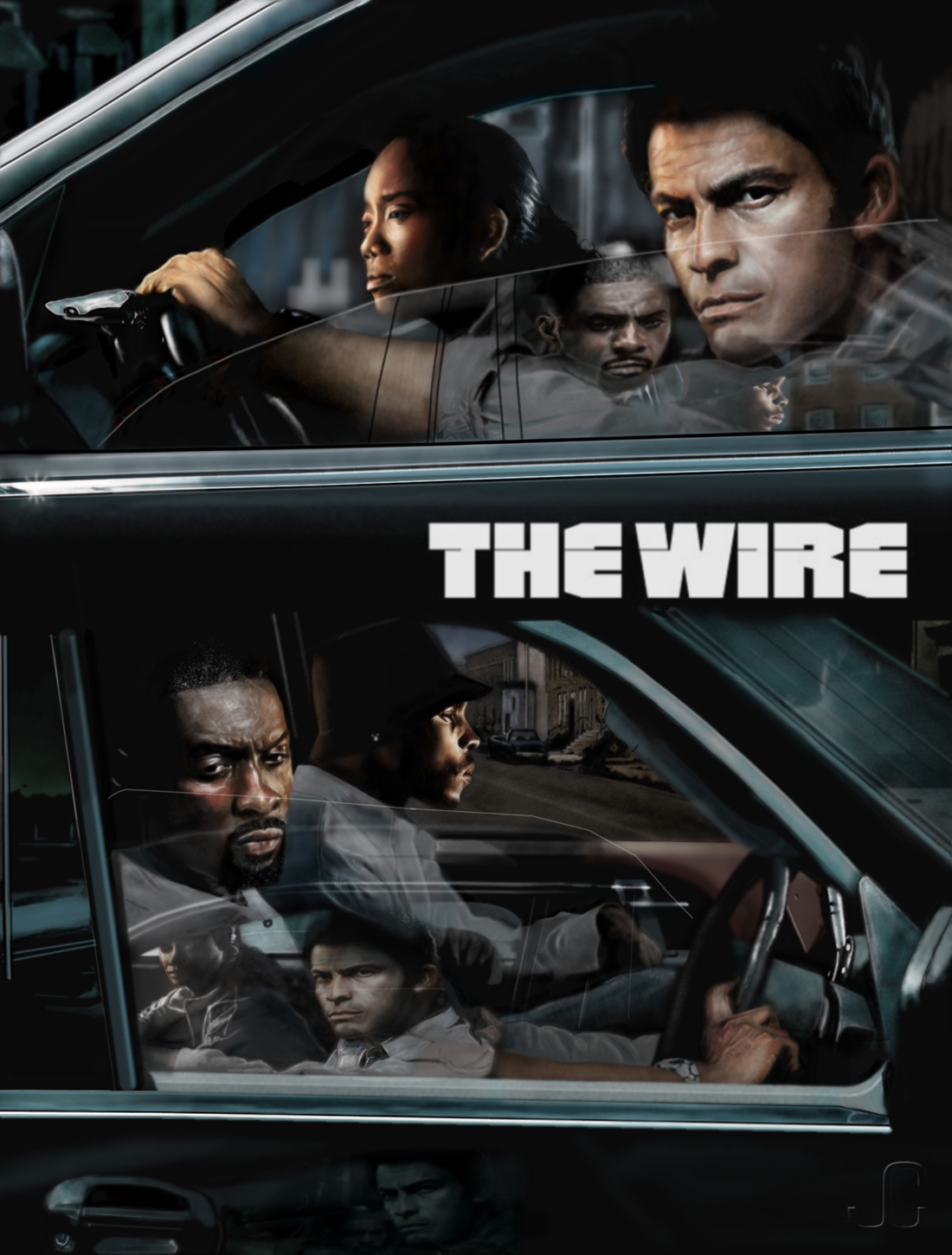
Oh dear, what a disappointment. We’ve watched about four episodes of The Wire so far and, since seasons 2, 3, 4 & 5 of The Shield are on their way to us, I doubt we’ll be watching any more. The first episode was a chaotic mess but we stuck with it in the hope of improvement and did begin to get a handle on what was going on, but that chaos was but a minor problem amidst many larger ones.
Let’s start with the language of this, which is a big downside for the English viewer. Not only is American English sometimes difficult (how often have I given up on the mumblings of Brad Pitt) but the gang and police slang in this is nigh incomprehensible. It took me three episodes to realize they were saying ‘terraces’ and not ‘terrorists’, and generally I understood about half of what was said.
The next problem is that if I’d wanted to watch a show that was 80% office politics I wouldn’t have bought a cop show. Frankly it is fucking boring. The paper shuffling and dick waving contests of bureaucrats is not something I find entertaining. It’s depressing.
Then there are the characters. Okay, if there was just one person here who I was pulling for, that might have made a difference. However, they are all wounded, damaged screw-ups, all detestable twats, and if someone were to napalm the lot of them I’d shrug and actually consider watching the next episode. I’m guessing this is all supposed to be realistic depiction of life on the street, man, right-on with the social ‘issues’ etc. If I want realism I watch a documentary.
In The Shield I had identified and had some empathy for every major character within the first episode, which was an entertaining story in itself. Four episodes of The Wire have left me annoyed at having taken any notice of the hype, wishing I could get my money back, and considering whether to bother handing it in to a charity shop or binning it. Life is too short for shit, really.
Ah, there’s nothing quite like writing the two words above. They mean I’ve finished the first draft of the latest book, in this case, Zero Point. However, by no means has the work ended, only word-counts have ended. While writing a book I aim for 2000 words a day five days a week (a target I often miss), and I record the number of words to drive myself. That’s no longer necessary.
Zero Point is at 152,000 words and will probably grow as I have yet to write my characteristic chapter starts. It will be, as I’ve mentioned elsewhere, about the size of The Skinner. Hereafter I’ll probably be deleting as many words as I write as I apply a number of rules. If I’m waffling I delete it, if it’s not relevant to the plot, or to character or world building, I delete it. Time lines and timings have to work. Polemic, while fun, should be either discarded, or consigned to one of those chapter starts where the reader has the liberty to either read and enjoy it or ignore it. Mostly it will be discarded. The English will need tidying up. Lots.
It may be the case that during this process I’ll chop out some large chunks because they add nothing or need completely rewriting. These I’ll consign to the file with the title Jupiter War, where I may use bits of them. Time for a celebration now? No, because I’m still in temperance January. I’ll save up this thirst for next month.

Okay, not April 1st. I think that what must have happened is that I somehow did something or was involved in something that’s shoved me off main-line time down the probability slope into the Twilight Zone.
Chinese National Television Xinhua news is now reporting an impending extraterrestrial disclosure by the Obama administration.
The unprecedented national China TV news bulletin that U.S. President Barack Obama may be preparing to disclose U.S. relations with specific extraterrestrial races was broadcast on the official channel Xinhua on January 4, 2011 on the eve of China President Hu Jintao’s state visit to the United States.

Okay, enough already! Who drugged me into a coma for three months last January? And why did they think it funny to wake me up on April 1st? This is silly … or is it?
A Nobel Prize winning biologist has ignited controversy after publishing details of an experiment in which a fragment of DNA appeared to ‘teleport’ or imprint itself between test tubes.
According to a team headed by Luc Montagnier, previously known for his work on HIV and AIDS, two test tubes, one of which contained a tiny piece of bacterial DNA, the other pure water, were surrounded by a weak electromagnetic field of 7Hz.
Eighteen hours later, after DNA amplification using a polymerase chain reaction, as if by magic the DNA was detectable in the test tube containing pure water.
Oddly, the original DNA sample had to be diluted many times over for the experiment to work, which might explain why the phenomenon has not been detected before, assuming that this is what has happened.

I really don’t know what to make of this. Is it a load of bullshit or is it true? If it is true it is a major game-changer. It’s the kind of thing that could utterly transform the world. Go and read the article over on WUWT and the ensuing comments.
Cold fusion isn’t usual fare for WUWT, at best it’s not a focus here, at worst it’s sorry science, and we talk about that enough already. However, it never has died, and this week there’s news about it going commercial. Well, it won’t be available for a couple years or so, but the excitement comes from a device that takes 400 watts of electrical power in and produces 12,000 watts of heat out.
Most people regard cold fusion as a black eye on science. It’s credited with the advent of science by press release and its extraordinary claims were hard to reproduce. Yet, unlike the polywater fiasco of the 1970s, cold fusion has never been explained away and several experiments have been successfully reproduced. Neutrons, tritium, and other products kept some researchers working long after others had given up. Even muons (from Svensmark’s Chilling Stars) have been suggested as a catalyst. Everyone agrees that theoretical help would provide a lot of guidance, but for something that flies in the face of accepted theory, little help has come from that.
Megawatt laser weapons. I think I may have to go lie down in a darkened room. More here at The Register.

I’ve been using bubble metals in my books ever since Gridlinked, and since I read an article concerning foamed metals. The basic idea was predicated on what could be produced in zero gravity manufacturing. If you foam a metal with an inert gas on Earth the bubbles will rise to the top so the distribution will be uneven. Do it in zero gravity and you have much more control over the process. Here’s a new take on the idea:
A new material is tested to cut the weight of ships by 30 percent. For an average sized freight vessel with a capacity of 7000 m³ this corresponds to a weight reduction of more than 1000 tons. Researchers from Fraunhofer Institute for Machine Tools and Forming Technology in Chemnitz, Germany, have experimented with an aluminum powder that foams when heated up (Jan ’11)
The new material is lighter than water and has a high stiffness. Within seconds a cube made from aluminum starts to inflate into the shape of a sponge under the impact of heat. The secret of this reaction lies in the compounds of the new material. The metal is a mixture of aluminum and titanium hydride powder, which acts as a blowing agent just like yeast makes dough rise.
The aim of the researchers from the EU research project CREATING was to find a processing method to build large aluminum foam sandwich plates. These compounds could eventually replace steel plates of a vessel. To form such sandwich compounds, the powder is initially pressed into bars. The bars are then placed between two steel sheets and heated in an oven. At a temperature of more than 650° Celsius the new material expands and bonds with the steel sheets without the help of any adhesives.
Consider the implications for aero industries too. I wonder about the possibilities of foaming a metal with helium…