Polity Agent Review — Walker of Worlds.

Here’s another review from Mark Chitty as he steadily works his way through his backlog of my books:

Polity Agent is the fourth book in the Agent Cormac series, a series I’ve been catching up with and thoroughly enjoying. The second and third books in the series, The Line of Polity and Brass Man, dealt with the emergence of Jain tech and Skellor’s use of it and was a fairly self-contained duology within the main story. Of course, just because that sub-story concluded it doesn’t mean everything is fine, far from it – Jain tech is still out there and Polity Agent hits the ground running.

As a runcible opens from 800 years in the future the team that were sent to return the Maker to its civilisation in the Small Magellanic cloud comes through in a panic, the Makers overrun by Jain tech. With runcible time-travel not recommended by the AI’s of the Polity due to the huge power requirements and dangers it involves, this situation is used solely to destroy the Jain infested Maker civilisation and most of the Small Magellanic cloud. This event raises many questions, most prominent of them being the purpose of Dragon, the huge bio-construct that the Makers created and sent to the Polity. Meanwhile an entity called Legate is distributing Jain nodes to certain people within the Polity, one of these being Orlandine, a haiman who takes a whole different approach to studying the Jain technology she has in her possession, while another is a dangerous separatist leader on the planet of Coloron. Meanwhile Horace Blegg, the infamous immortal of legend, is slowly learning more and more about jain tech and of himself, while Cormac continues to discover more about Dragon while trying to limit and eradicate the spread of Jain tech. And then there is the King of Hearts, a renegade AI whose journey out of the Polity leads him to discover something very dangerous indeed.

Polity Agent can be found here on Amazon and here on The Book Depository (free international shipping).

Thirty Days of Night

I read the Twilight series and I enjoyed it. Even though there are those reading those words who will sneer, I write them because long ago I decided I would not go the route of the literary snob or the pretentious twits who choose to associate themselves with books and films they feel enhance their literary cred. I chose to be honest about my likes and dislikes. I don’t like lies.

I also enjoy films like Interview with a Vampire and From Dusk Till Dawn because I love the ideas of immortality and the superhuman, especially with the added spice of those concerned being somewhat amoral, or immoral. Until now, my favourite vampire has always been Mr Barlow from the film of Salem’s Lot – the scene locked in my mind being the one where we first see him in a prison cell – but now he’s been knocked into second place.

Last night I watched Thirty Days of Night which in atmosphere was a bit like John Carpenter’s The Thing, what with the dogs, the cold and the desperation. It’s set in a small Alaskan town in the dead of winter, when they lose the sun for a month. It’s a town that gets cut off from the rest of the world. It becomes a feeding ground, and there you’ll find the best vampires ever, but not in a good way. If you want an antidote to the pretty, angst-ridden vampires of recent times, get this film and watch it.

Energy Catalyser.

More on that reactor I posted about previously. Apparently it’s not ‘cold fusion’. Full interview is here.

[The following interview of Andrea Rossi by blogger Daniele Passerini was originally published on Jan. 25 and is reprinted courtesy of Ventidue Passi D’amore e Dintorni. The English translation is provided courtesy of Shirakawa Akira. Passerini also prefaced the interview with his own comments (not translated here) in a short introduction titled “Toward Infinite Energy and Beyond.” Rossi and Passerini have confirmed to New Energy Times that this English translation is factually and linguistically correct.]

PASSERINI. Good day Engineer Rossi, I thank you for accepting this interview. Everybody is asking themselves how you managed to perfect your Energy Catalyzer? Somebody even suspects that you stole the idea, for example, from Professor [Francesco] Piantelli from the University of Siena, who in the 1990s worked together with Professor [Sergio] Focardi on “cold fusion” research. Could you explain us where, why, how and when you started working on this project?

ROSSI. I started in 1987. As the facts show, my process strongly differs from previous efforts: Nobody has managed to manufacture a working device so far. Facts count, not words.

PASSERINI. 1987 would mean two years before the strongly disputed Pons-Fleischmann experiment. Recently, you stated that it’s not proper to define the reaction occurring in your catalyzer as “cold fusion” and that it’s more correct, at the moment, to generically define it as a weak [force] nuclear reaction – in other words, low energy, or LENR. Are you telling us that you went on a different road, parallel to that of “cold fusion” research?

ROSSI. Exactly. In fact, mine is not “cold fusion” but weak [force] nuclear reactions. Pons and Fleischmann did heavy-water electrolysis with a palladium cathode and a platinum anode. I don’t do electrolysis, I don’t use either platinum or palladium and I use temperatures that manage to melt nickel.

Outcasts.

So, the BBC is starting a major new drama series.

Set in space with the future of earth looking increasingly precarious, the race is on in Outcasts to find an alternative home in the universe.

Apparently, to get to this alternative home the outcasts travel through some kind of tranporter, but,

Outcasts is a tense and fast-paced series about co-operation and conflict, idealism and power, sexual competition and love. Most of all it is about our life’s big imperatives – cheating death, seeking suitable mates and surviving as a species.

And it is definitely not science fiction. According to the designer, James North, who previously spent 5 years designing sets for Dr Who, ‘…the BBC doesn’t want to give the impression it’s putting out a sci-fi show on prime-time BBC1. This is a futuristic drama with the focus on pioneering humans who, out of necessity, just happen to be living on a planet that is not Earth.’

Let me give my deeply considered opinion on the above statement: what a wanker.

New Fuel

I noted this on the Internet a little while ago and now the snail-media newspapers have caught up with it. You can find articles here at Popsci and gizmag:

UK-based Cella Energy has developed a synthetic fuel that could lead to US$1.50 per gallon gasoline. Apart from promising a future transportation fuel with a stable price regardless of oil prices, the fuel is hydrogen based and produces no carbon emissions when burned. The technology is based on complex hydrides, and has been developed over a four year top secret program at the prestigious Rutherford Appleton Laboratory near Oxford. Early indications are that the fuel can be used in existing internal combustion engined vehicles without engine modification.

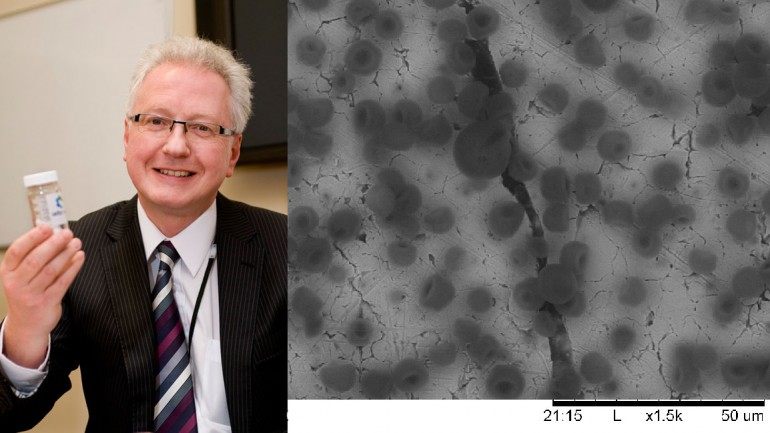
Cella Energy have developed a method using a low-cost process called coaxial electrospinning or electrospraying that can trap a complex chemical hydride inside a nano-porous polymer that speeds up the kinetics of hydrogen desorption, reduces the temperature at which the desorption occurs and filters out many if not all of the damaging chemicals. It also protects the hydrides from oxygen and water, making it possible to handle it in air.

In the papers I’ve seen the price as 90 pence a gallon and 19 pence a litre. This all sound incredible, wonderful and just the sort of thing we need. And I have huge reservations. We’re told in the articles that present day car engines will not need to be modified, but go to the Cella website and we get, ‘it is possible to convert a conventional internal combustion engine (ICE) to run on hydrogen with minimal engine modifications’ which is not quite the same really. Fuel tanks and exhaust systems are not mentioned. I’m presuming that the micro-beads themselves are not burnt, that the hydrogen evaporates from them, so fuel tanks will have to be emptied as well as filled. Think of the infrastructure involved.
 
But for fuel of that price, surely we could set this in motion? Yeah, right, it’s going to be that price. Ho ho. Lest we forget, if we bought petrol at the pump without government taxes it would cost 47 pence a litre. If you go here you’ll see that not only do we pay 59 pence duty, the government then taxes us on the tax we pay on fuel, that is, VAT is charged on the actual fuel price + delivery charge + duty. Does anyone reading this think for one moment that our government would give up on such a lucrative way of screwing the population? Do you think for one moment it would give up on 20 billion in tax? If some cheap new fuel came in the government would just look upon it as a way of increasing its tax take. This basically defines the attitude of all governments to tax.

Is SF Getting More Conservative?

Interesting article here at Pyjama’s Media, and a very interesting mass of comments ensuing. This is mostly American-centric so definitions of conservative, left, liberal etc are slightly different from the British version. I’d also submit that the question in the title is one that wouldn’t even be asked here. ‘One swallow does not a summer make’ would be the relevant proverb.

I am a complete science fiction geek.

It started when I was little more than a toddler. One of my earliest memories: sitting in the basement with my parents as they watched Walter Cronkite narrate one of the Apollo missions as it rounded the moon. (Which one? I couldn’t have been more than three or four, and I was born in 1971. You do the math.) It left an impression. I’ve been a fan ever since.

In the last few years, I’ve noticed more and more that science fiction has taken a bit of a turn to the right. I’ve also seen more than a few reviews lambasting those authors for their views — which seems to matter not a whit to their sales.

So I emailed four of them — two relative newcomers and two legends — and asked why.

The legends, Dr. Jerry Pournelle and Orson Scott Card, need no introduction. But it bears mention that Ender’s Game, Card’s best-known work, is on the Commandant of the Marine Corps recommended reading list as a treatise on what it means to be a leader. The newcomers, Lt. Col Tom Kratman (Ret.) and Larry Correia, both write for Baen.

The Blade Itself — Joe Abercrombie

When, on the first page of The Blade Itself, a major character went ‘Eeek!’ as he avoided a spear thrust, I nearly put it aside. My feeling was one of, ‘Oh FFS, not another fantasy with a central silly character who bumbles through the plot tripping over his magic sword squealing and running away then managing to destroy the [insert relevant baddy] through pure luck.’ But the writing was engaging and I carried on. This particular character developed into one who really wouldn’t go ‘Eeek!’ so I wish an editor had had the presence of mind to strike a line through it. The other subsequently introduced protagonists were also well-developed in this character-driven fantasy, which reminds me of some enjoyable stuff I’ve read in the past. If you want comparisons I’d say about 70% Eddings and 30% Gemmel – a sword-swinging romp. The book did seem to terminate rather abruptly, but then it is the first book of a trilogy, which I think is well worth a look for fantasy fans. I just apply my usual rules whilst reading: Am I bored? No. Am I enjoying myself? Yes. Will I buy the next two books? Yes.

Before They Are Hanged

The Last Argument of Kings

Update (From The Man Himself):

Hey Neal,

Eeek.

The irony is, that eek isn’t in the published book, only in the proof. My editor did indeed strike her line prior to publication…

But many thanks for the review. Be interested to hear what you think of the rest of the trilogy if you do get round to it. I reckon it gets better and better.

But then I would say that, wouldn’t I?

Best,

Joe Abercrombie