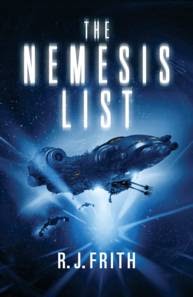
The Nemesis List — R J Frith

I wasn’t going to write a criticism of this book because I do have some negative things to say and, really, I don’t like doing that. I much prefer to give a good review of something I enjoy and ignore what I haven’t enjoyed (and probably haven’t finished). However, on balance, I’ve come to the conclusion that the good outweighs what I see as the bad in some of the biggest and most fundamental ways. Why have I come to this conclusion and why have I changed my mind?

Just recently I delved into a large tome produced by someone who is supposed to be a big shot in the fantasy genre and after about twenty or thirty pages started to lose the will to live. It was utterly boring. It was swords and sorcery transforming into soap opera. Next I picked up a big fat science fiction tome and the effect was precisely the same though took a shorter time to take effect. Both these books are published, both by supposedly proven writers. R J Frith the winner of the War of the Words competition hosted by Tor UK and Sci Fi Now magazine gives us The Nemesis List, and it is worth your attention.

My particular gripe is that Jeven Jones, the main protagonist of this who is a ‘fast-tracked evolutionary leap into the future’ comes across as pretty ineffectual and damaged considering that there seem to be vast dark forces trying to track him down. Throughout the book there was the promise of something extraordinary from him but it didn’t seem to arrive. I wanted to give him a slap and tell him to sort himself out, which I guess shows how well he comes across as a character. I could also see that the Jeven Jones character was quite similar to the girl with psychic powers in Firefly. But you really have to remember that all this is my subjective response.

Now to why I think it’s good: I read it from cover to cover without any feeling that I was losing interest or wanted to put it down. I enjoyed this book and, frankly, if there’s a follow-up I want to read it. It was dark, quite assured, and Frith can get you to emotionally invest. I am, even now, considering reading it again to see if I can get a better handle on it, and that doesn’t happen often with me.

Do I recommend it? It’s flawed but promising and yes, I do, because whilst some of you out there will hate it, I rather suspect that there will be others who will think it is the best thing they’ve read in a while.

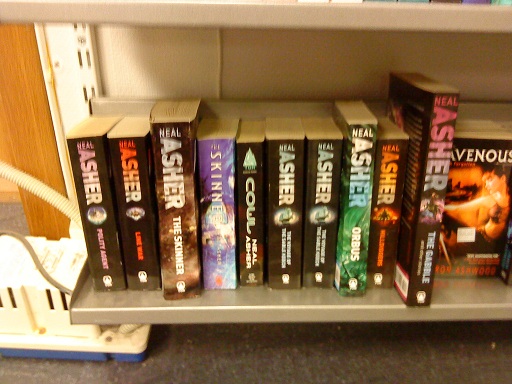
Books in Outland, Trondheim – Norway

Two pics for you from probably the best bookstore I have ever been in. A proper store that sells it all from Manga to GFX Novels to ‘proper’ books.

The guy in the picture works there and was very happy to be photographed. He has your website so hopefully he will pop on and say hi!

We have 3-4 book shops here with your stuff but we only need the best one 🙂

Sorry about the blurry 2nd image, old knees…

Hitch.

Books in Waikele, Hawaii.

Thanks to Sean Price for sending this picture. He was a bit reluctant. I’ll let him explain why.

I was hesitant to send you this picture but then I realized you’re probably more interested to see how well you sell–or not–in various places instead of just getting pictures that give you an ego boost.
(Um, I quite like ego-boosts – Neal)

I’m not sure what to make of the meager selection except to attribute it to Border’s financial woes. They’ve filed Chapter 11 and after visiting the store it’s apparent that this was not a sudden decision. When I first discovered your books–several years ago–you had an entire row, hardback and paperbacks included. Now…not so much. However, this isn’t just your books. The pickings are very slim–even for the pulp authors with numerous titles–so I’m guessing that Borders is just not replenishing their stock. Lots and lots of empty shelves…

A fair selection of books from the Best Seller lists but back stock for authors…? It’s like crickets chirping on most of the aisles.

I rarely visit the store anymore since I do the majority of my book buying through Amazon (Kindle) so I hadn’t realized how bad it’s gotten.

I suppose I could visit the Barnes and Nobles store down in Waikiki, but that will have to wait as I rarely have the patience (or willpower) to deal with the traffic situation down that way. 🙂

Anti-laser

And of course I’m thinking about Polity dreadnought defensive systems…

New Haven, Conn. — More than 50 years after the invention of the laser, scientists at Yale University have built the world’s first anti-laser, in which incoming beams of light interfere with one another in such a way as to perfectly cancel each other out. The discovery could pave the way for a number of novel technologies with applications in everything from optical computing to radiology.

Conventional lasers, which were first invented in 1960, use a so-called “gain medium,” usually a semiconductor like gallium arsenide, to produce a focused beam of coherent light-light waves with the same frequency and amplitude that are in step with one another.

Last summer, Yale physicist A. Douglas Stone and his team published a study explaining the theory behind an anti-laser, demonstrating that such a device could be built using silicon, the most common semiconductor material. But it wasn’t until now, after joining forces with the experimental group of his colleague Hui Cao, that the team actually built a functioning anti-laser, which they call a coherent perfect absorber (CPA).

Oops, get back to those copy-edits Neal!

Header Picture

You’ll see the header picture has changed (as has the link which will now take you through to my virgin website). However, the row of books there are my old covers. Does anyone fancies creating another header picture using my new covers? The advantage for me in someone doing it is that I don’t have to spend time playing about in paintbrush to do it. The advantage for any reader that does it is that I’ll spend more time writing the next book or post about writing…

On Writing: The Contents File

Every so often I will take a look at the work of writers who want to get their feet on the first rungs of the ladder leading to publication. But first let me make a distinction here. These are not wannabe writers since they are actually writing. They are not those who say, ‘I always wanted to write a book about so-and-so,’ to which the reply must always be, ‘Then why aren’t you writing it?’

Sometimes those who contact me are those in love with being a writer more than writing itself, though that is no barrier, just so long as they actually do write. Sometimes they are those trying to learn the secret handshakes and arcane rituals that will lead to publication. There aren’t any – you have to be stubborn, persistent, prepared to learn and take a lot of knocks, and in the end you have to write something a publisher thinks will make money.

I will look at a sample of the work these people produce if I am not right in the middle of something, if I happen to feel so inclined, if they are not rude and pushy and if I get some sense that they’re actually looking for advice, rather than praise. Sometimes I get that last one wrong, tear someone’s work apart, and know by the affronted response that they have learned nothing.

So what am I waffling about here? Having recently taken a look at someone’s work (Hi Khaled) and tried to ape the Peter Lavery scary pencil with a red pen, I thought it might be a good idea to start doing some posts here on what I see as the nuts-and-bolts of writing. As and when something occurs to me on that subject I’ll do a post here under the label ‘Writing’ to slowly build up what I hope will be a useful resource.

Today I’ll ramble on about a contents file:

A book is a large chunk of text. Now I know I’m stating the obvious but how, unless you have an eidetic memory, do you keep track of it all? Here’s my method. Generally my books are about twenty chapters long, each chapter broken into sections that can be just one or as many as six pages long. Each of these sections is written from the point of view of just one character. Let me digress for a moment:

To my mind a common mistake I see is the switching of POVs sometimes from one paragraph to the next. This is confusing for the reader. It can also cause the reader to fail to engage with the characters.

Continuing… I keep track of a book by first bookmarking each of my chapters as I write them. After I’ve written a couple, I then open another file with the pages (usually about two) switched to two-column mode. In the case of Gridlinked, for example, this file is called ‘gridcontents’. In this I list the chapter number followed by a very short description of each section in that chapter. If required I’ll add timings. This is useful for keeping track but it’s also handy because I am writing down what happens in each section. If I can’t sum up ‘what happens’ this probably means I’m waffling and the section might be better cut, or the useful elements of it distributed elsewhere. Here’s a sample from ‘orbuscontents’:

Chapter 7.
U-space Missiles
Vrell hunts mutations.
Prador kamikazi
Orbus to hunt Vrell
Golgoloth to Oberon
Jain starts to wake

There’s something further to add here. As many of you know, I don’t particularly do a lot of planning before writing a book, so I don’t produce a summary or synopsis beforehand. However, after I’ve handed the book in and as it heads towards publication, my publisher wants to get people interested and give them some idea of what it’s all about. At this point, with the book finished, the contents sheet comes in useful for writing the synopses. I copy the contents sheet, get rid of column mode, then work through turning each short description into a paragraph or so. Next I take that and begin melding it; losing some of the straight-line chronology to focus on the story, on what it is all about. This usually results in about six pages of single-spaced text. After that I’ll make a couple of abstracts – one at about half the length and one summing it all up on a page.

The art of précis is well worth learning.

Here endeth today’s lesson.