House of Suns — Alastair Reynolds.

I finally got round to reading this (I really needed the escape) and enjoyed it immensely. Mr Reynolds also got double royalties from me due to my increasingly disfunctional memory – I bought one copy through either Amazon or The Book Depository, and then picked up another in Waterstones.

It has everything I want from him: huge concepts played out on a vast stage, enjoyable characters, gobsmacking technology (bollocks to nanotech, he goes straight for the jugular with femtotech) and a great story extending across aeons. I particularly liked the way, at one point, that he sneaked around causality. Some might think, with his adherence to the galactic speed limit, that he’s made a rod for his own back as far as story telling goes. It strikes me that a consequence of him limiting himself to sub-FTL travel is that the stage expands to somewhere approaching its true size. What Reynolds does best is give some sense of the true scale of what lies out there. Maybe that’s something difficult to achieve without spending years peering through a telescope and letting the vastness of what you see settle in your bones.

I’m probably speaking to the converted when I say, ‘Highly recommended,’ since most of you reading this blog have probably already read this book.

Footnote.

The character Purslane in this book received a hologram of an emerald beetle. I can’t find that particular section at the moment but it sticks in my mind because this bugger landed in Caroline’s lap only a week before I started reading the book.
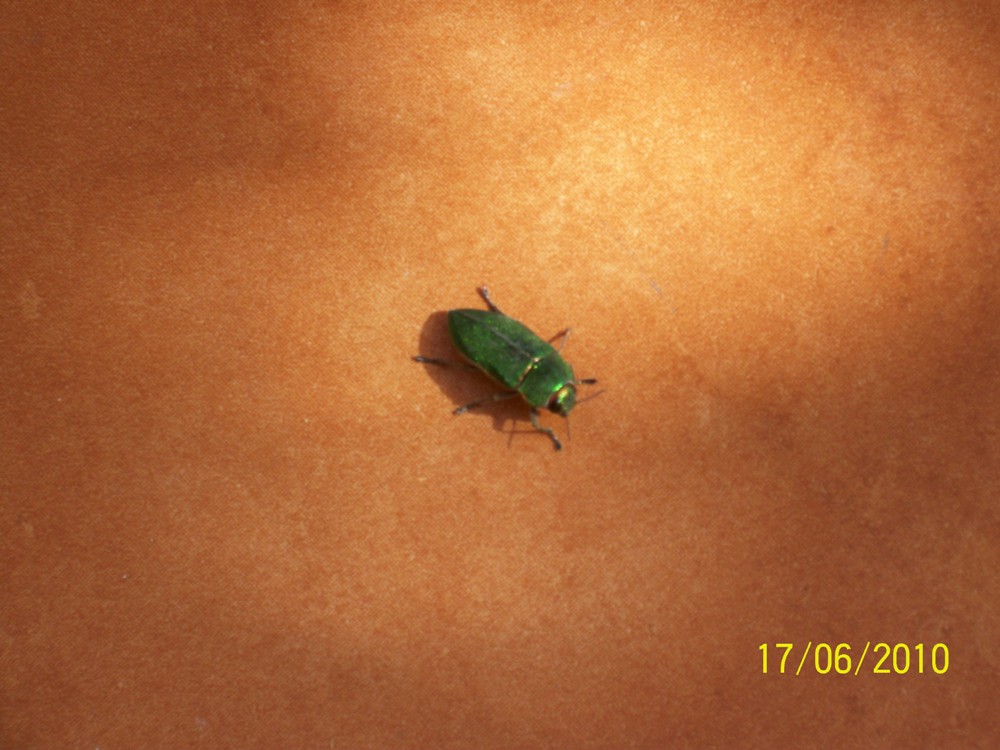
The interconnectness of things? Just the inevitability of human brains full of experience and knowledge interfacing with large books full of … experience and knowledge.

Insect Porn.

I photographed these two up on our pergola and, my goodness, an insect’s life might be a short one, but it’s certainly a merry one. These two were at it for three hours in the afternoon and then, the next day at about the same time they were still there, so maybe they were bonking for twenty-four hours. But then, considering what happens to a praying mantis male after he mates, maybe the male here (cricket or locust) spent all that time figuring out how to get off without being eaten. Anyway, it’s certainly springtime because shortly after seeing these two we noticed a couple of birds on the nearby roof occupying themselves similarly.

Our ruin now has a roof. Laying the concrete slab, the plaka, took six people: one up on the roof spreading the stuff, one mixing, and the others hauling up big buckets of mix. Luckily the weather was just right for the job: cloudy with a few spatters of rain. The problem with laying concrete here, when the weather is mostly hot and sunny, is that it tends to go off too quickly and crack. It is also the case that after it has been laid it must be frequently soaked. To keep himself occupied after the job, so he could periodically go up to the roof with a hose pipe, Mikalis suggested we use my new barbecue. He got the meat and I provided the salad and the beer.

At midday the concrete was down, the barbecue fired up, the beers in a cool box. The weather had improved by then so we all sat eating barbecued pork ‘brisolas’, salad heavy on the salt and olive oil, fresh bread that was so good it needed no butter, and supping chilled bottles of Amstel. You gotta love the attitude of these guys to the working life. Caroline and I retired after a few hours and left them to it, then after it was all over, I went up to hose the roof four times. Mikalis, obviously concerned that the thing didn’t crack, also turned up in the evening and hosed it down once more. Right now, as I type this, I can hear electric chisels going as they take out the old pointing and remove the old render from the walls ready for repointing.

Now, this is a science fiction writer’s blog, though you wouldn’t think so reading the last few posts here. Sad to say, with everything going on around here, I haven’t achieved as much as I would like to on the writing front. But not to worry. Since I managed to do the last two books well before time, I’m three months away from when I should even start the next book. Zero Point has reached 19,000 words and the story is progressing well. I don’t really want to say too much more about it, since you reading this have yet to see the first book of The Owner sequence, The Departure, which comes out in August 2011 when I am to deliver Zero Point.

The Road — Cormac McCarthy.

In the past, like many readers of genre fiction, I have been overcome with guilt about my addiction and a mistaken urge to self-improvement. I’ve fought narcolepsy through the first hundred or so pages of War and Peace, I enjoyed my journey East of Eden, been mildly irritated by To Kill a Mockingbird and been surprised at my enjoyment of The Life of Pi and the The Story of the Dog in the Night-time. Throughout an adult education English A Level I was first repelled by Congreve, Othello and The French Lieutenant’s Woman, then told the requisit exam-passing lies about how I enjoyed Richard II and The Bell by Iris Murdock. So when Julie Crisp at Macmillan suggested I read The Road by Pulitzer-winning doyen of the literati Cormac McCarthy, I did have some reservations.

Upon discovering that the present state of my back prevents me from doing light labour, and that sitting at a computer for too long results in me being unable to lie flat when I go to bed, I picked up The Road and decided to give it a try. I expected to struggle through twenty or so pages of pretentious twaddle then, depending on the strength of my reaction to that, either give the book to one of the free lending libraries down in the bars in Makrigialos, or usefully employ it in our stove here.

There was some to criticise here. The bare bones writing thing was taken too far with the dropping of apostrophes, which grated, and the lack of speech marks, which sometimes led to confusion. However, the only pretension I found was in the praise the reviewers heaped on The Road. Superlatives abounded in the descriptions of this shattering, searing, utterly compelling, haunting, gripping, brutal, heart-rending story. One twit linked it to global warming and nearly stopped me at the cover, but luckily I ignored that and read on. The Road is about the aftermath where the ‘math’ isn’t really important. If you wanted to be picky this seems to be set in that other possibility-hyped-to-catastrophe the nuclear winter. The reviewer concerned was just going with the ‘right-on’ lazy groupthink, as so many of them do.

So what is this book about? It is about a man and a boy struggling to survive in a burnt and lifeless world as they take the road south, where the man thinks it will be warmer, or rather, it’s about carrying on without hope. It’s the black, white and grey of the cover, stark, dismal, bleak. I read it in about 4 hours and never regretted a second. I even forgot about my back-ache. Recommended.

Started Zero Point

Okay, this is a first; I started the new book Zero Point on 16th April. This is a first because I have never before actually recorded when I’ve started a book, only when I’ve written the last line. 3500 words done thus far (yeah, I know, but I had holes to dig in the garden, seeds to plant, walls to scrape off and repaint etc) and, all being well, I’ll soon be getting on with my 2,000 words a day five days a week.

Other stuff to occupy my mind: planting a pomegranate tree, obtaining a big plastic container and burying it in the garden for the grey water, and translating a leaflet detailing a garden health plan here. The last comes from a guy who sold me pomegranate trees in Sitia. The simple exercise of going to him and buying four trees (some for friends) at a price I already knew, took half an hour whilst he told me everything I must do to plant them and look after them. He then had to detail stuff about a further two plants I bought – a cucumber and a melon. I have to wonder how he makes any money when an explanation for two simple plants at a total of 90 cents rambled on for ten minutes. Later he caught Caroline and I walking back to our car, and gave further explanations, along with the leaflet. You gotta love this place.

It’s nice to note that the banana tree I planted last year, which was a brown dead looking mass when we came back, is now throwing out new leaves. Also, in the same part of the garden, an avocado tree (about four inches high) has survived. This last comes from a meal of avocado and prawns eaten about two years ago – the pits shoved in a pot outside.

So, all the planes across Europe have been grounded for about a week. I didn’t realise until I saw the location of the volcano on a map just how close the thing is to Britain. Some people are stranded here too, though sitting in the sunshine drinking beer as they await notification of their flights. I don’t have any memory of this sort of thing happening in my lifetime and wonder what other effects there will be. Certainly, the European economy doesn’t need this right now, but what about the weather? I guess we can all be assured that the global warmers will have something on which to blame this coming year’s cold.

We walked to a place called Etia a couple of days ago. This is an old Cretan village containing a restored Venetian villa (and a taverna). People who buy houses there can restore them, but only to the period of the place, though I suspect that doesn’t mean mud roofs and no electricity. We had a nice meal in the taverna, with a couple of beers, then walked back, picking wild gladioli and flowering broom (shit, there went my street cred).

Still no joy with the Internet. I’ve put my name forward as one of the hundred required to get broadband up here. The woman, Marita, who I said could put my name down, tells me that we only need to find about 90 more…

More Zero Point Stuff.

The three Zero Point Energy books progressed to a stack in the hall – ready to go down to one of the bars in Makrigialos that keep books to loan out to customers – but then I decided to bite the bullet and have another go with them. There’s certainly some interesting real science in them, like the Casimir effect, Casimir batteries, the possibility of solid-state rectification of ZPE and the Alcubierre warp drive. The problem I have is sorting the nuggets of gold from the crap-heap. The book that first detailed the stuff above included a piece by one Richard Boylan Ph.D suggesting that declassifying ZPE technology would be a good thing – that would be the ZPE tech the Americans obtained from ‘Star Visitors’, which included antigravity tech. Oh dear. It all read very coherently, but it was like a post I once read on the Asimov’s message board – a perfectly coherent explanation by a guy of why he believes the Earth is only 6,000 years old.

This sort of stuff puts me in mind of the state of play a few centuries back as real scientists researched electricity, magnetism and electric fields, and as new technology began to result from them. Whilst the real scientists worked with real problems and conducted real research, a whole crop of pseudo-scientists grabbed these new shiny toys and attributed to them the kind of properties previously attributed to holy relics, bathing at Lourdes or rubbing yourself down with damp celery to cure leprosy. Newspapers of the time were full of adverts for electrical or magnetic treatments to deal with every ailment from gout to cholera. Of course out of that crap-storm came some real stuff, like X-rays, ultraviolet light skin treatments (I choose those because we’ve been watching Casualty 1900s).

Here, according to the book I’m reading now, are the paradigm camps regarding ZPE:

1. Quantum physics is wrong. Quantum events can be explained classically using self-fields. ZPE does not exist.

2. Relativity is wrong. A material-like ether exists.

3. Quantum physics is correct, but ZPE is a theoretical artefact; it is not real.

4. The ZPE physically exists, but its magnitude is too small to be an appreciable energy source.

5. The ZPE physically manifests large fluctuations, but they cannot be tapped because of entropy; they are random and ubiquitous like a uniform heat bath.

6. The ZPE is a manifestation of chaos in an open nonlinear system. Under certain conditions it can exhibit self-organisation and therefore become available as a source.

7. The ZPE is a 3-space manifestation of electric flux from a physically real, fourth dimension of space. It can be twisted into our 3-space yielding alterations in the space-time metric. It can be tapped as a source, and doing so locally alters gravity, inertia and the pace of time.

I think I can live with number 7, just so long as the tech doesn’t come from greys from Alpha Centauri or secret Nazi projects, just so long as there are no homeopathic, acupuncture or crystal healing miracles involved, just so long as the Zero Point Field isn’t God and our souls don’t transmit to the fourth dimension when we die etc etc etc.

More Crete Stuff.

Still no luck with the Internet – it turns out that OTE just don’t provide it up here in the wilds. Basically they provide it where there will be sufficient users to pay for it and, since our village with its population of 60 has only two people who are likely to use it, I don’t see it arriving in a hurry. Our only option would seem to be something from Vodaphone, which I’m guessing is expensive and limited. Ah well. The plus side of this is that though my communications will be intermittent and my posts here not as frequent as previously, I won’t have my work interrupted by the Internet.

However, my work is being interrupted by something else. Despite asserting that I would never put games on my computer, I’ve done so. I’m playing various hidden object games and am presently on Mortimer Beckett and the Time Paradox. If I work at it I can kid myself that this is research…

It turned cold here for a few days and, since we were running low on wood and needed to keep the stove burning, I made some enquiries about buying some more. Gulp. 150 Euros for a pick-up truckload. I guess I have to remind myself that back in Britain, over ten years ago, a pick-up full of cut wood would cost £50 and, compared to Crete, Britain is covered with trees and full of people who use gas and electric heating. Here, when it’s cold, the chimneys are smoking constantly.

I bought the wood from an Albanian living here who, like them all here, has a Greek name as well as his Albanian one. His name here is Vangelis whilst in Albania he’s called Angelos. I don’t get that, since the latter is also a Greek name. The Albanian who did some work on our house is Yorgi to the Greeks but I call him by his real name: Miri, or Simira. A similar thing happened to me when we first came here. Our neighbours couldn’t quite handle Neal so renamed me Nico, yet they were perfectly alright with Caroline. Go figure.

Incidentally, look out for some Greek names and references in future books from me. In The Technician, for example, there’s an AI called Ergatis, which in Greek means ‘worker’.

Zero Point Energy … or Not?

So, the first book of my new contract is to be called Zero Point. In the past I’ve read fragments about zero point energy and thought it seemed like a good science fictional tool I could employ. My plan was for the title to have a double meaning. Zero point energy would be employed as an inertia-less drive for a space ship, whilst there would also be a link to certain ‘year zero’ events I don’t really want to go into here. I therefore bought some books about zero point energy so as to learn more about the subject.

Oh dear.

I started reading then failed to finish three books on the subject. The impression I get is one of wish fulfilment, of, as one scientist has noted, ‘the modern equivalent of the search for a perpetual motion machine’. There’s plenty of science involved and zero point energy, according to current theories, does exist, but when I start reading about its connection to Chakra points and acupuncture, homeopathy, the soul and the ‘energies that bind us all together’ I start to consider whether the book might better serve as fuel for our stove here. That was one of the books. Another one started rambling on about how zero point energy would solve global warming, whilst another referred to Nazi technology and secret projects on American air force bases, and I put it aside before Area 51 got a mention too.

It seems to me that using zero point energy might be about as daft as having my heroes gunning each other down with lasers powered by cold fusion – also connected to zero point energy.

Now, I know, from the ‘Who Reads My Books?’ stuff here, and other contacts with readers, that an awful lot of you work in proper science-based professions. I know there’s a good chance that one physicist, two biochemists/geneticists and hundreds of high-function IT people will be reading this. I also know that there will be many others who love SF and understand science (the two are inextricably linked) who will be reading this. So tell me, what is your opinion of zero point energy?