I think I can say firmly that I have now started Penny Royal (or Pennyroyal – I still haven’t decided). A week or so back I started making some notes, but then got distracted by my old website and reworked that. (Incidentally, if you haven’t noticed there are galleries and a forum there so, as far as the latter is concerned, if you have something you want to say that you feel is off-topic, pop over there.)
Tag: Science Fiction
The Quantum Thief — Hannu Rajaniemi
In a way this was more like a fast tour of the post singularity world rather than a story set in it. I’ve been reading science and science fiction for a very long time, but I often felt the need to hold up a finger and say, ‘Hang on Hannu, if you could explain –’ … but no, he’s gone like a tour guide on speed. The ideas hit you like cars in a motorway pile-up giving you no time to deal with them, absorb them. And, of course, while the ideas are hitting you like that you’re not properly processing the plot and can fail to engage with it. My feeling is that before he leapt through the next q-dot membrane to begin his next adventure in some gaming virtuality he needed an editor to catch hold of his collar and force him to stop and smell the roses, even if those roses were laced with an optogenetic virus.
Now for the however… This was all very enjoyable, bubbling with fascinating technology and its resultant life-styles, and a book that really does feel like a glimpse into a post Vingean singularity world. I found myself caught up in the author’s enthusiasm with it all and by the end of it wondered if someone has slipped amphetamines into the printer’s ink. For me it is a book I would like to read again, but with the Internet running so I can track down and nail all that glorious weirdness. And in the end, just like with the previous book I reviewed here, the answers to the questions are mostly ‘yes’.
The Lost Fleet 'Dauntless' — Jack Campbell
There’s a whiff of antiquity about this book that reminds me of E.E. Doc Smith and other books I read at about the same time I read the Skylark series. This feels like WWII but with space ships and could easily have been written in the 50s. I felt momentary cringes at the name of the character ‘Black Jack Geary’ at the use of ‘hell lances’ and ‘grape shot’ and at crewmen being called ‘sailors’. The technology felt daft, as if the electronics aboard the ships might have employed thermionic valves, as if the corridors were full of steam pipes and the gunners were hand-loading shells. I half expected someone to pull out a slide rule at some point to calculate vectors.
Why shouldn’t a beam weapon be called a ‘hell-lance’ and why shouldn’t ‘grape shot’ fired at relativistic speeds be perfectly acceptable? How different is the former to a maser or particle beam, and how different is the latter to rail-gun missiles? And why shouldn’t the kind of command structures seen in our navies be used? Such arguments I tried on myself as I devoured this book. What retired naval officer John G Hemry (his real name) has done here is combine his experience of military service with an obvious (and probably dated) love of science fiction.
To sum up: all of the above is true, but in reviewing a book I have to ask some very simple questions. Did I care about the characters? Did I want to know what happened next? Did I enjoy reading this book? Was it a good read? Will I buy the next book in the series?
The answer to all these questions is ‘yes’, and this book must be included in that long list called ‘guilty pleasures’.
Prador!
Poster
Updated Website
Okay, for all you techy minded IT guys. I’ve rebuilt my website using the program Webplus X4. I still need to do a lot more work on it. A lot isn’t displaying as well as it should, it could do with navigation bars and I’ve yet to make the ‘video clip’ page.
Jain Tech on the Way
I love it when a rush of articles like this appear on TheNext Big Future. Here we have a microscopic engine:
“We’ve developed the world’s smallest steam engine, or to be more precise the smallest Stirling engine, and found that the machine really does perform work,”
Here we have further efforts at miniaturization using carbon nano-tubes:
Three dimensional integration is a hot field within electronics since it offers a new way to package components densely and thus build tiny, well-functioning units. When stacking chips vertically, the most effective way to interconnect them is with electrical interconnects that go through the chip (instead of being wired together at the edges) – what are known as through-silicon vias.
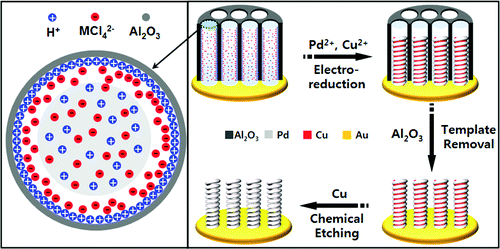
Here we have nano-springs:
In order to exploit the particular material properties that appear at the nanoscale, it is first necessary to fabricate materials with nanoscale structures in a controlled and repeatable fashion. Reliable methods for the fabrication of simple shapes such as nanorods, nanocubes and nanotubes are now available, but more complex shapes still pose a challenge. Sungho Park and co-workers from Sungkyunkwan University in Korea have now reported a promising method for the synthesis of palladium nanosprings.
Researchers from the University of Science and Technology of China, Hefei in collaboration with colleagues in Germany and Austria have now demonstrated a system that allows photons to be entangled and stored in a manner suitable for quantum computing.
And photonic chips for quantum processors:
A multi-purpose optical chip which generates, manipulates and measures entanglement and mixture – two quantum phenomena which are essential driving forces for tomorrow’s quantum computers – has been developed by researchers from the University of Bristol’s Centre for Quantum Photonics. This work represents an important step forward in the race to develop a quantum computer.
Of course with steady developments like this we might end up with some sort of self-replicating technology that grows like a plant, or a fungal mycelia…
New Book
Right, I’ve finished with the Peter Lavery edits of Zero Point, have read through it once more, and I’ve now sent it off. Of course this is not the end, because a copy editor will go through it next and doubtless have queries for me and, if I wished, I could now return to Jupiter War and start working it over again. However, I’ve decided it’s time to look at something different.
This afternoon I opened a new file and titled it Pennyroyal, stared at a blank page for a moment and then typed in that same word as the title. I’m now halfway down the page making notes – putting down things I’ve churned over in my mind on and off for a number of months. Here’s the first thing I wrote:
The traveller keeps a piece of Pennyroyal inside his own ship: a black spine a metre and a half long, the width of an arm at its base and tapering to a needle point, pentagonal in cross-section and with corners of atomic sharpness, a ribbed tentacle extending from its base, with a tentacle junction box a handbreadth down it, and a metre of tentacle beyond – torn off at the end with optics and esoteric electronics protruding.
This may be something I’ll use or it may be something to key me into the book and which I’ll discard later. Other ideas are fermenting and bubbling to the surface. There’ll be connections here to the Prador-Human war, but it will be set after The Technician. A spider-thrall might be involved, and I’m considering a guest appearance by Jebel U-cap Krong. I also see one of those giant AI-dreadnought manufacturing stations, maybe a wartime atrocity…
Hey, this post is longer than the notes I’ve made…
Back to work!
The Windup Girl — Paolo Bacigalupi
My opinion about this book is difficult to nail down. It was rich and textured and engaged all the senses, the characters were fascinating, too, and the extrapolation and some of the ideas were excellent. I particularly liked the kink-spring technology and the semi-retro tech based on it, like the disc guns that are a reminder of a childhood toy. I enjoyed the genetic manipulation and the wind-up girl herself, though of course there were shades of Blade Runner there. However, what gave me pause was the heavy reliance on scares generated by the ‘green’ movement and the MSM, but of course, in present day establishment thinking, it is right on.
We have the scares about global warming and sea-level rise here, and you all know my opinion on them. Yes, we do have global warming, and we’ve had it since the Little Ice Age and it hasn’t come close to being as high as in the Medieval Warm Period and has flat-lined for over a decade. As for sea-level rise, putting aside Al Gore idiocy and desperate IPCC spin, the last time I looked it was few millimetres a year (as it has been for 8000 years), and if we can’t cope with a metre rise in sea-level in three or four centuries then we might just as well give up right now (it has also been dropping for the last three years). However, the clue is in the label. This is science fiction so writing about a future globally-warmed and flooded world is valid, though, extrapolating from historical climate cycles, and writing about a new Ice Age, would be more so.
Then we have the scare about genetic modification or, more specifically, the fear of GM under the control of the evil corporations (sigh). Here we seem to be going into Daily Mail ‘Frankenfoods’ territory, combined with the ‘capitalism is evil’ shibboleth of the left. I am a little doubtful about the idea that our scientists are going to abruptly pull masses of world-devastating monsters out of their arses that billions of years of competitive evolution has failed to manage. But whatever, again this is valid for science fiction, and is of course a very useful spanner in the SF toolbox. I also get tired of that constant portrayal in fiction and film of the evil corporation. It strikes me that corporations seem to come up with most of what improves our lives, while it’s the governments that enjoy bombing people back into the Stone Age.
(I also have to wonder … where are the windmills and tide-generators supplying if not electricity then joules for those kink-springs? Where, with such advanced biotech, are the tank-grown hydrocarbons and the CO2 absorbing microbes? Where, also, are the nuclear power stations? Maybe in the rest of the world?)
Thereafter, if the scares were true, the extrapolation in the book is on the button. I do see Luddite environmental police (white shirts much like Hitler’s brown or black shirts) destroying illegal and dangerous technology and pillorying those who are profligate in energy use. I do see an economy based on calories, and the kind of life-styles depicted in this book. And I do see human life being cheapened.
Now I have to add something more. I have, over time, started to make it a rule that I won’t review books I either don’t like or don’t finish. That I finished this book, considering my personal opinions, is testament to how much I enjoyed it. It’s a valid look at a future from one point of view and, unlike what I have seen in other SF books that venture into this sort of territory, the characters are people struggling to get on with their lives in difficult circumstances, and are not vessels created just to deliver righteous homilies.
Cue the visits by trolls to enlighten me in the ways of correct political thought.
Kardashev Scale
Noting this article on Next Big Future reminded me about the Kardashev Scale, and reading up on it again can certainly be a stimulus for the imagination.
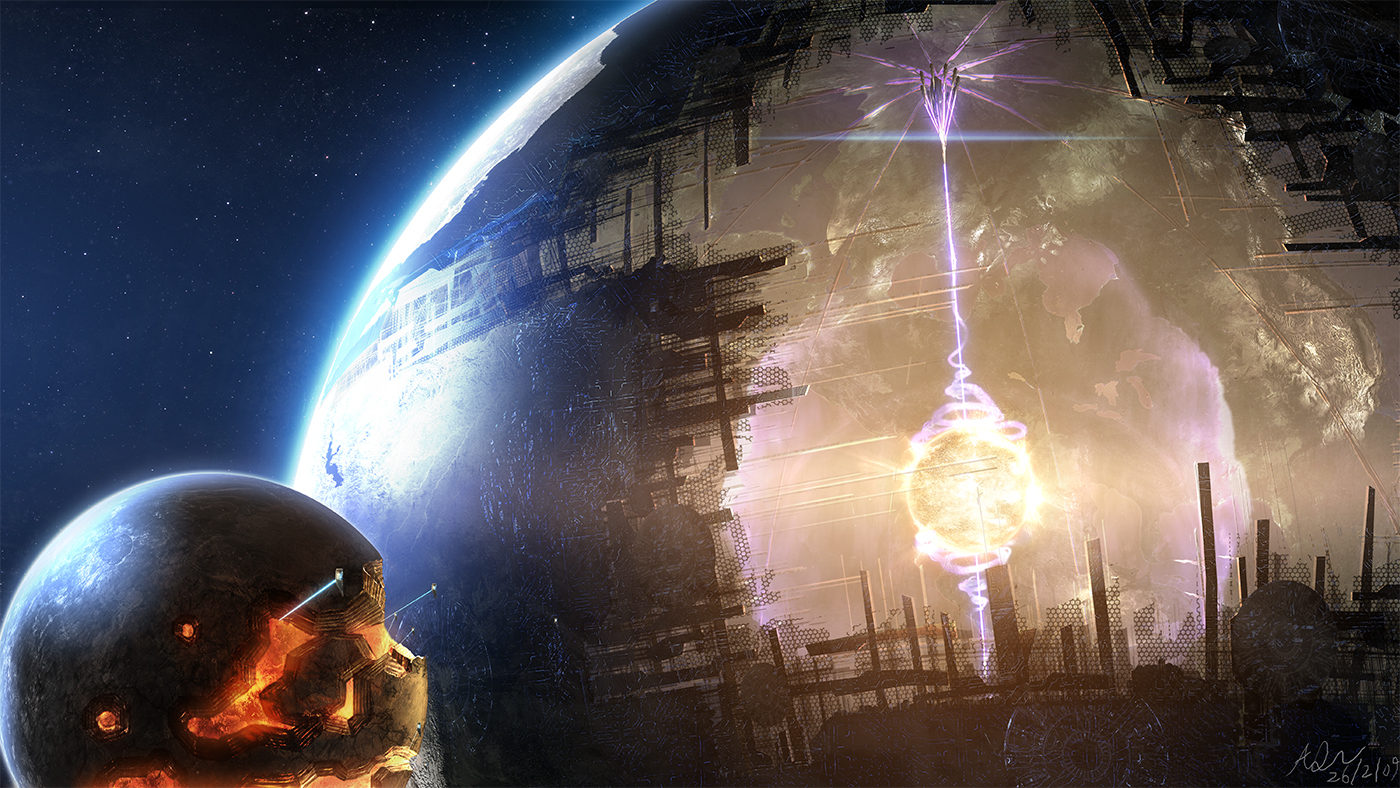
The Polity, I suspect, is merely a Type I civilization, perhaps sliding into Type II territory with the construction of a Dyson sphere. The Heliothane, of Cowl, are also edging into Type II territory with New London sitting over the sun and tapping energy from it. Go check out the links to get your mind blown … so to speak.
The picture here is one from Halo, which seems to have some seriously cool artwork.