The Broken Lands – Fred Saberhagen

I’m sure I’ve encountered ‘the magic comes back (or is revealed)’ after some catastrophe many times before, but the only one I can think of at the moment is Stephen King’s The Stand. Though it’s not stated I would guess, going by the time this was written, the catastrophe here would have been nuclear war. So technology is lying around, sorcerers raise elementals, and agents of the evil empire of the East are enslaving the good farming folk of the West. A boy whose parents are killed is set on a course of vengeance and joins the revolution . . . and thus far it is all pedestrian and predictable. But the Eastern ruler fears the elephant, for it has been foretold to bring him down and now, to throw a SPOILER in: it doesn’t have legs but treads and runs on nuclear power. I didn’t enjoy this as I remembered. I think that’s more to do with my mood and wanting to get onto what I remembered as the good stuff. New readers may well enjoy it a lot more because, being pretty much fantasy, it’s not really gone past its use by date.

Image may contain: text that says "LALCEM THE BROKEN LANDS FRED FRED SABERHAGEN Who can control the unleashed power of sorcery and ancient lore?"

Destination Universe! – A E Van Vogt

Enjoyable old SF stories of variable quality. I wonder if it is because they are so old that’s what makes it possible to enjoy them. The anachronisms are large, the whole milieu dated, even if in a supposed future, that there is no need for that ‘suspension of disbelief’ because these are not something one can hope to incorporate in a world-view. I mean, if you read a modern SF book you can mentally draw a line from our present to it. No matter how fantastical it has the illusion of the possible. These old SF stories have slid off into a parallel, off of our world line into the not possible at all. But they are enjoyable, amusing and a window into social and SF history. Antique futures.

No photo description available.

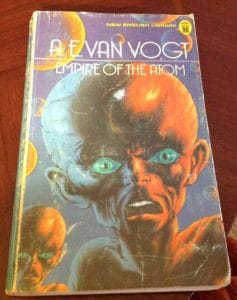
Empire of the Atom – A E Van Vogt

Terry Pratchett once took the piss out of ‘quantum’ in that it explains everything and it can do anything. Another one for modern SF is ‘nano-technology’ and both are essentially equivalent to abracadabra. But go back the over 70 years to when Empire of the Atom was written and we have just entered the atomic age, and of course ‘atomic’ is the word. Atomic ‘stuff’ can do anything and it is like magic. Only a few physicists knew any better, so the ridiculous ‘science’ of this escaped scrutiny and now with, as Aldiss once described his collection STAN, that ‘whiff of antiquity’, this book is sliding into fantasy. Add in the armies and sword waving battles on Earth, Venus and Mars that come straight out of Edgar Rice Burroughs and it has firmly arrived. Yet, despite all that, I enjoyed the wry observation of human nature, the intrigue and that most important element of all: the story telling.

The Book of Ptath

This cover is amusing – you couldn’t make one that’s more irrelevant to the story inside. I imagine that with Van Vogt being an ‘SF writer’ the publishers were struggling to give what is fantasy an sfnal look. 200 million years in the future the god Ptath wanders back into his realm after a long absence. He has no memory, is virtually indestructible, and is immediately snared up in the machinations of the goddess Ineznia to seize his power. I found my mind wandering with this one – too much introspection and plain dumb behaviour from Ptath, ideas not used properly (like the 1944 mind in his skull), the idea of Ineznia’s oppression increasing worship for him wasn’t clearly expressed (these gods derive their power from worship) and it all fizzled a bit at the end.

Image may contain: text that says "Panther Science Fiction The Book of Ptath A. E. van Vogt Author of Slan Slan and The Mind Cage Panther 02753X"

Away and Beyond – A E Van Vogt

Yes, there are anachronisms in these stories, like paper records, the need to get to a phone when spaceships are zipping round the solar system, instrument panels with old radio dials on them and a machine that cuts holes through hyperspace, yet runs on thermionic valves. But oddly I didn’t find these too jarring. The last machine mentioned was developed in WWII so yeah, it would have been valves and radio dials. Others like The Great Engine, were of their time (set in the late 40s) though as ever with old SF like this, it moved on to an earth-like Venus – the other option being one covered in hot jungle. Some stories ended abruptly and anticlimactically. But then I get to the last story, Asylum, where Van Vogt gets into the stuff I really like from him: superminds, Dreel space vampires and the Galactics. A worthy read – I enjoyed it!

No photo description available.

Cult of Me Interview

This one round about the publication date of Dark Intelligence. Amazed to see, down at the bottom, I was still using my Virgin Freespace website then.

Please introduce yourself, who are you and what do you do?

I’m Neal Asher science fiction writer, one of the big boys in British space opera if you believe some, or a hack who snuck in under the wire if you believe others. But though it’s nice to define myself as a writer, I am and have been other things too. As the biography on my blog says: I’ve been an engineer, barman, skip lorry driver, coalman, boat window manufacturer, contract grass cutter and builder. Now I write science fiction books, and am slowly getting over the feeling that someone is going to find me out, and can call myself a writer without wincing and ducking my head.

I started off being published in the small presses – in the days when most magazines were still printed and posted – getting my first short story published back in 1989. After that I worked my way steadily up the writing ladder to actually be paid for a story some years later, then producing a couple of novellas and an anthology after that. I was taken on in 2000 by Macmillan and have been overproducing for them ever since. Thus far they have published 17 of my books while I’ve also done a few on Kindle myself. My stuff is translated into 10 or so languages, into audio books too, but no film yet.

What first inspired you to start writing?

I have a standard pat answer to that. I’ve always had an interest in all sorts of stuff – chemistry, biology, electronics, art, reading and writing – but it was all a bit scattershot. I realized that to achieve anything in any of them I needed to narrow my focus i.e. I was a Jack of all trades but master of none. I chose writing because it could include an eclectic selection of those other interests. However, this pat answer does not explain the thrill I get when I hear Paperback Writer by the Beatles or the yearning I had when I used to watch the old Melvin Bragg program for which it was the theme tune. I guess I got so much pleasure from my reading of vast amounts of SFF I couldn’t see a better job than being one of those who produced it.

And what attracted you to writing science-fiction?

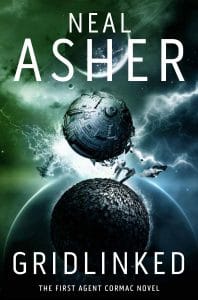
Science fiction sort of found me. I wanted to write and the next step was publication as vindication of that. I started off writing a fantasy (in pen on paper then typed on an electric typewriter – I have to add that I have actually done real cutting and pasting!) and completed a trilogy plus the first book of another one. These I was sending to big publishers, and they were promptly sending them back. Next researching smaller markets I wrote articles and short stories. I then discovered the SFF small presses and started producing science fiction short stories for them. Meanwhile I wrote a contemporary novel, then I wrote my first SF novellas like Mindgames: Fool’s Mate, The Parasite and The Engineer. Only after these and numerous short stories did I attempt something larger, and that was Gridlinked. I reckon the reason I didn’t start off straight away with science fiction was that I was aware that I did not know enough. Contemporary stuff you write about the extant world, for fantasy you make it all up (though logical consistency is required) while for SF you have to have a pretty wide knowledge of science before you make it all up on the basis of that.

If you could spend a day with anyone from history, who would it be and why?

I’m not really sure that there’s anyone. There are many I’ve admired from afar but I don’t know them. I’m old enough and wise enough to now know that someone can be an icon in the public world but that does not necessarily mean they are not an arsehole in private. I’ll keep my illusions.

Which author do you most admire and why?

I have so many I admire for so many different reasons, or sometimes because of one book. For singular books it’s the likes of T J Bass for Half-Past Human or James Kahn for World Enough & Time (and there are others). Then there are those writers who have never disappointed, whose every book I have read and kept: Terry Pratchett, Iain M Banks, Roger Zelazny, Tanith Lee, Sheri Tepper, C J Cherryh, David Gemmell, Alan Dean Foster … Aaargh! I could just go on and on.

What is your favourite word?

I try not to have a favourite word because, as a writer, I want to use the best word for the job. I was once accused of overusing ‘candent’, but I’m all better now and don’t use it so much.

Where is your happy place?

Usually I would say swimming in the Libyan Sea off the coast of Crete or eking in my garden at my house there. However, my wife Caroline died of bowel cancer this January and right now I don’t have any happy places.

What are you working on at the moment?

Over the last year or so I wrote the first draft of a trilogy concerning and AI called Penny Royal. This entity first appeared in a short story called Alien Archaeology (published in Asimov’s and a Year’s Best anthology) then in my book The Technician. This trilogy has the overall title of Transformations and the books are: Dark Intelligence, Factory Station Room 101 and Spear & Spine. Presently I’m editing them.

Tell us about your latest work and how we can find out more.

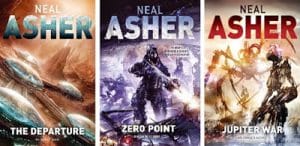
The next one to appear will be the first mentioned above – scheduled to be published next February. The last book I had published was Jupiter War, the last in the Owner trilogy, the prior books being The Departure and Zero Point. If you want to find out more about these books and all my others there’s plenty of information on my website http://freespace.virgin.net/n.asher There’s also plenty of stuff on my blog at http://theskinner.blogspot.com I can also be found on facebook at neal.asher or on Twitter @nealasher And of course my stuff can be found in all good book stores online or on the high street.

Cheers!

My Other Stuff

Since being taken on by Macmillan I’ve published getting on for 30 books, but not all of them are from that publisher. I’m not a writer who had instant success with a big publisher. As I have noted elsewhere, I climbed every step of the ladder, sometimes with people stepping on my fingers. I’ve had numerous short stories published in magazines that no longer exist now, novellas and collections similarly launched by ‘small presses’ that went to the wall, and others that didn’t and are still selling some of my old stuff.

All of this happened before the advent of Kindle and Amazon’s POD (print-on-demand) books. I went from sending stuff by post along with return postage to that excellent invention called email. Wow! I could send stuff without having to print it out! Though, admittedly, at the time small presses insisted on hard copy before any emailing happened. Then, as now, there were many wannabe writers who would have created an email deluge.

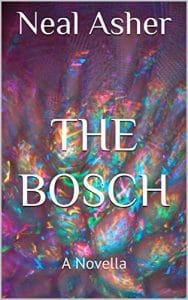
Anyway, since being taken on by Macmillan I’ve published a fair bit of this stuff on Amazon. Recently, because I could, I published a 21,000 word novella called The Bosch, and again discovered there are plenty of fans who don’t know about ‘My Other Stuff’.

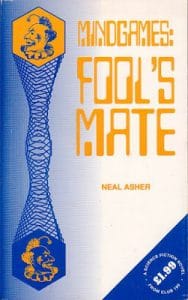
I’ll go through, kinda, in order of original publication. The first thing that was not a short story was a novella I originally titled To Die But Once. I’d found out about a press aiming to sell airport short reads called ‘Club 199’ and sent this effort of to them. It surprised the hell out of me to get an offer for it of £1,000 and I snatched it up. The novella (45,000 words) was duly published but then, not long after and (I think) due to changes in the ‘net book agreement’, Club 199 went down the pan. I didn’t my much like their title change to Mindgames:Fool’s Mate because it reads like an observation. Here it is on Amazon. It just has a generic cover on there, not this one. Up in my loft I have about twenty or so of the originals in shrink wrap – bought from a distributor who tracked me down in later years. I may sell them off one day.

Jason Carroll, an ex SAS soldier and contract killer is convinced he will die in action. It is thus embarrassing when he is run over by a bus. It is even more embarrassing when he, an atheist, realises there is an afterlife…Resurrected on a huge flat plain, he is forced to play a deadly game. Moved as a pawn to the whim of the Gods in a fight to the death with warriors from all ages of earth’s history. Killed again and again only to be resurrected.

The General, the Grim Reaper and Anubis are some of the strange beings who direct this grisly entertainment. Is it real or only in his decaying mind. Who is the Clown? It there anywhere to escape to?

To retain his sanity, he must believe there is an end; an escape; a purpose. A thought-provoking story leading to an action filled climax that challenges our accepted beliefs…

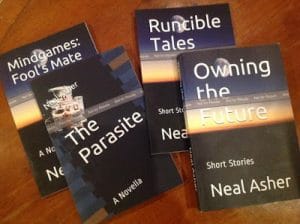
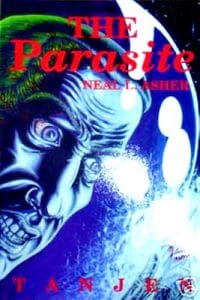
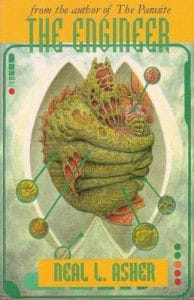
While this was being published I was banging out stories to those small magazines when a new small press called Tanjen took an interest. First up they published a 40,000 words novella called The Parasite. After that they published a collection of short stories called The Engineer. Tanjen was another of those small publishers that went to the wall. The Engineer is still published by Wildside Press in the US (but available here too) but under the new title The Engineer ReConditioned with a couple of extra stories. The Parasite I published myself – again in a generic cover.

After mining complex ices deep in the Solar System, Jack Smith is concerned about his profit margin, but is it him who doesn’t want to face quarantine or something squirming inside him? The Cryon Corporation Director, Geoffry Haven, is also concerned about the bottom line and might consider Jack an expense he can no longer afford, though perhaps suitable for a starring role in a snuff movie. Meanwhile, the human and unhuman agents of World Health must investigate. Perhaps it’s time to deploy vat-grown killers and an anti-photon weapon, because the parasite is coming to Earth, and it’s hungry.

The Parasite was first published by Tanjen Ltd as an illustrated novella back in 1996. Tanjen closed down a number of years later and since then the novella has been difficult if not impossible to obtain. There are copies out there, but checking recently I haven’t seen one for below $50.00, which is a hell of a lot for something only 130 pages long and perhaps only for completists. I’ve edited it again, thought I haven’t been too heavy-handed since I didn’t want to deliver something that had completely ceased to be the original. This is my first attempt at self-publishing through Amazon Kindle. I hope you all enjoy it!

“Once again, Neal Asher gives his reader a meal of such exquisite taste that you’re left like Oliver, desiring more.” – Authortrek

Mysterious aliens … ruthless terrorists … androids with attitude … genetic manipulation … punch-ups with lasers … giant spaceships … what more could you want? This great collection of 10 short stories by the author of Gridlinked, The Skinner, In the Line of Polity, and many more is a great read!

I also, at some point, did a couple of longish stories called Africa Zero and The Army of God and the Sauraman. These were first published in a magazine, but are now published under the single title Africa Zero by Wildside Press. Only available in paperback I think.

The novellas Africa Zero and Africa Plus One in one book. The Collector rampages across a far future Africa populated with gene-spliced vampires, resurrected mammoth, and nutters with APWs. But he can handle it.

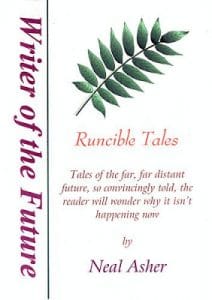
In the late nineties, still looking to find homes for my stories, I came across a publisher called Piper’s Ash and sent them a few stories. They published five short stories under the title Runcible Tales and kept on selling this little chapbook even after I was taken on by Macmillan. When they too finally went to the wall I stuck that on Amazon too:


This is a ‘chapbook’ of five short stories so not very long (about 30,000 words). It consists of: Always With You – Webster engages on a mission to destroy a Prador planet breaker. It helps if you have Horace Blegg on your side, and an internal medic, but are these enough to overcome overwhelming odds? Blue Holes and Bloody Waters – marine biologist Karl finds that humans haven’t quite adapted enough – or have they? Features the first mention of the retro Anti-Grav cars featured in “Gridlinked” that I have come across Dragon in the Flower – Ian Cormac’s first encounter with Dragon – this is printed word-for-word in “Gridlinked”, so this should be the Runcible Tale most familiar to Neal Asher readers The Gire and the Bibrat – Telepath John Tennyson is given more than a helping hand by Agent Prime Cause in his search for the location of a scream… Walking John and Bird – John Walker consults Horace Blegg and Dragon with questions concerning his link with Bird, a seemingly invincible entity. Trouble is, especially where Dragon is concerned, he may not like the answers.

Another small collection was Mason’s Rats. These three short stories were first published in a magazine, then published in the form of a booklet the editor of that mag distributed at an SF convention for publicity. Yup, those too, though you can only get them on kindle as the amount of text is too small for POD.

With the above I’d about caught up with the novellas and collections. However, I still had (and still have) numerous short stories that need a home. To that end I put together a collection of them called Owning the Future – this title because some are set in the ‘Owner’ universe of my books, some in the Polity and some elsewhere.

I have a varied collection of short stories in my files and, of course, the temptation is there to dump them on Kindle, take the money and run. However, though I think some of them are great, some aren’t, and some are profoundly dated. I am aware that there are those out there, who will just buy these without a second thought, so I have to edit, be selective, and I damned well have to show some respect for my readers. Kindle in this respect can be a danger for a known writer, because you can publish any old twaddle and someone will buy it. Time and again, I’ve had fans, upon hearing that I have this and that unpublished in my files, demanding that I publish it at once because surely they’ll love it. No they won’t. A reputation like trust: difficult to build and easy to destroy. I’ve therefore chosen stories other people have published here and there, and filled in with those I really think someone should have published. Here you’ll find some Polity tales, some that could have been set in the Polity (at a stretch) and some from the bleak Owner universe. Enjoy! Neal Asher 04/06/18

One outlier people may not know about is a short story, published in my collection for Macmillan The Gabble, that they put out for publicity by itself. This is Snow in the Desert.

In the parched, arid wastes of this far-flung Polity world, Snow is being hunted. With a prize on his head and his life in danger, trust is a luxury he can’t afford. Hirald, pale and deadly in the blistering heat, is an ambiguous presence. But who is she? What does she want from him?
Mankind has sought Snow’s secret for thousands of years, and blood will flow in the desert before it’s revealed.

Snow in theDesert is compelling, brutal and lingers long after the final word: the perfect introduction to Neal Asher’s Polity universe fiction.

So now we’re up to date, or rather, up to date as I write this. In 72 hours perhaps not because I’ve stuck a novella up for Kindle and POD called The Bosch.

And it’s up!

Getting There

Here’s one from way back before I was taken on by Macmillan, so interesting for new writers climbing the ladder. Perhaps they will realise, what with Amazon Kindle publication and the ease of submission to magazines over the internet, that they never had it so good!

The first time novellist or short story writer is up a certain well known creek without even a canoe. If you’re a politician, a film star, or a model  (you don’t even have to be able to write), the big publishers will provide you with a nice fat cheque and a power boat. The catch for a new author is that they might publish you if you’re known and as a new author you’ll only get known if they’ll publish you. It is also a sad fact that the likes of Harper and Collins receive two to three hundred manuscripts a week out of which they might publish two or three a year. Many large publishers freely admit that they will not even look at work unless it is submitted through an agent. It would also seem that these publishers are now run primarily by accountants and financial directors. Editors wanting to take on something new have to present this work to these people to justify the expenditure. As such justifications usually begin with, “Well this is like … ” the chance of anything groundbreaking being taken is minimal. The fact, I think, that all writers should be aware of is that these large publishers are not out to make books; they’re out to make money. So what other options are there? There are, thankfully, the small presses, and through them a gradual struggle up the ladder in the hope that you’ll reach a point where you can no longer be ignored.

Small press publications range from illiterate productions of stapled-together A4 sheets to some magazines indistinguishable from what you’ll find on the newsagent’s shelf. There are presses that produce paperback books of a quality that exceeds that of the mainstream publishers (How often have you had one of these mainstream paperbacks fall apart in your hands as you read it? How often has the cover picture and blurb born no relation to the contents?) It is worth noting exactly what ‘small’ means in the latter cases. It usually only refers to circulation, editor’s bank balance, and advertising. They are not necessarily small on enthusiasm or professionalism. Don’t be fooled into thinking that you can get any old crap published here, but also be aware that if you are good, you stand a better chance here than with one of the lumbering giants that has a stranglehold on the the newstands and bookshops.

Unfortunately the SF F and H (magazine) small presses are pretty much a closed circuit and it is quite possible for you to be very well known in them but not known outside. Very often the magazines published have a circulation that can only be numbered in the hundreds and not very many of them. The closed circuit is due to a large proportion of their readership being writers and by the mags only advertising in each other, (no doubt due to cost). What are you after though? If it is money then forget it. Payment ranges from a free copy of the mag your story is in to, if you’re really lucky, ten or twenty quid. The most I have achieved for short story publication was £60 from a magazine called Scheherazade and that was for ten thousand words divided over two copies. If it’s an audience you’re after then the most you can hope for is that for ten or fifteen minutes you will have the undivided attention of each of those hundreds of readers. Better than nothing.

A problem you’ll face, writing for these small circulation magazines, is their proliferation and their swift demise. I have frequently had stories accepted by magazines that have then folded before publication of said story. There is no fault here in the enthusiasm or even financial acumen of the editors. It is just that a circulation of any more than a few hundred seems a tough barrier to break. Some have managed to, but for every one that does it seems that twenty others go to the wall. That barrier I think is ultimately heart-breaking for many editors.

Another problem can be the lengths of time involved. In some cases you will not recieve a reply for a few months, thereafter, if your work is accepted, it can be months and even years before you see your work in print, and see any cheque that might be involved. This is because small press editors have to work for a living and that job ain’t in publishing. They have piles of stories to read through and reject before they find your gem. And often they might only bring out their magazines quarterly or even yearly. You’ll often notice when looking at these magazines that they’ll have an issue number, but that the editor has not been brave enough to put on a date. In one case I had to wait three years from acceptance of one of my stories until publication. But let’s face it, if you’re a writer, you should be thinking about your next story on the way back from the post box.

Why write for the small presses if your ultimate aim is big time publication? To begin with the small presses are a superb training ground for the wannabes. Very often the editors of these magazines will take time to offer some criticism of your work (remember, if that criticism is ‘this is drivel’ that’s more than you’ll get elsewhere). You’ll also get a fair amount of feedback in the letters pages and even in other magazines. In this sense the closed circuit will work for you; many of these magazines have review columns and as well as reviewing films, and large circulation books and magazines, they review each other. Also, because of that proportion of writers in the readership, you’ll know that if you do get published it is not because of a lack of submissions to the magazine. The small presses are essentially a proving ground for the wannabe.

To break into the small press market you do have to buy magazines. Some magazines will only publish stories written by subscribers; a form of nepotism brought on by a desperation to get subscribers. Once you’ve bought a few magazines you’ll have a feel for them and from adverts in them you’ll find other mags to which you may send your scribblings. Each time you send something off (with an SAE and covering letter) you’ll quite probably get fliers from yet more magazines with your rejection or acceptance. It is quite easy to build up one hell of a list of possible markets. If you want to increase that list then get hold of publications like Zene, Light’s List, or Dragon’s breath. In the fifteen years I’ve been writing for the small presses I’ve felt no need to submit work outside the UK, but then I’m not someone who produces a story a day.

Once you’ve broken into the small press market (meaning that you have proven your worth to yourself, not that you have learnt the funny handshake) it’s worth looking at the small press book publishers in the hope of having something longer published. As you do these things take note of your achievements and utilise what leverage they might give to get you higher up the writing ladder. Unfortunately though you’ll find that small press book publishers face similar difficulties to those of the magazine publishers. So far I’ve seen three of them get into difficulties.Club 199, a publisher aiming to produce cheap paperbacks (£1.99, hence the name) had the printing side of things organised but not the advertising side. New Guild, whom I was under contract with, made the same mistake. Tanjen, has recently ceased taking on any new work. Sadly, these small publishers are up against the huge advertising machines of the large publishers, the clout they have with the likes of W H Smiths and Waterstones, and the spreading of costs over huge print runs.

For me my writing has been a gradual struggle up that ladder, the small presses being the first few rungs. Too often we hear of someone getting the x-thousands advance on their first book and hearing this lose sight of the fact that they are the exception. There is a lot of truth in the image of the writer struggling away in his garret then drinking himself to death. The reality is that writing is hard, getting published is hard, and that if you want easy money your best option is to become an estate agent.

It took me five or more years to get my first short story accepted and then that magazine folded before publication of my work. After that slight boost (and it was a boost; someone had actually wanted my work) I got more and more stories published, the occasional novella serialised, and a one-off novella published for a single cash payment. For my short stories my reward was a copy of the magazine and some complimentary letters (mostly). After another five years I was getting the occasional cheque – about enough to pay for a toner cartridge a year – then in the following five years finally gained some notoriety through the publisher’s Tanjen, with the production of another novella (The Parasite) then a short story collection (The Engineer). My story, I warn you, has been one of relative success.

Where do I Start?

More and more frequently now people ask me, of my books, ‘Where do I start?’ I guess it can be a daunting prospect now I’ve published getting on for thirty of the buggers, but understand why many want to start when they see the enthusiasm of those who have been reading for some time. And it is to those long-time fans I turn to for anecdotal guidance.

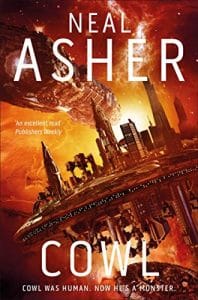
But first let me give you some idea of what these books (also novellas and short stories), are all about. Many of the books set in the ‘Polity’. This is a future in which AIs control the ‘Human Polity’ – a vast civilization taking up a large portion of the galaxy. Books about this future form the main body of my work, which consists of series, trilogies and ones that stand alone. I have also written books outside of the Polity set in other futures, but there are not so many of them. These are The Owner Trilogy – a dystopian near future – a one-off time-travel book called Cowl, and a few novellas published before I was taken on by Macmillan. The only books where you will find these futures are mixed together, is in some short story collections.

The Owner Trilogy


My fans often tell me of which books introduced them to my work. Quite often they will have picked up something in the middle of a series and, enjoying that, moved on to the rest to discover the order of the books. Others, who read my books from the beginning, prefer publication order, but publication order is not series, or the chronological order of this future. For example, publication order of the first books with Macmillan was: Gridlinked (Cormac book 1), The Skinner (Spatterjay book 1), The Line of Polity (Cormac book 2), Cowl (stand-alone time-travel), Brass Man (Cormac book 3) and The Voyage of the Sable Keech (Spatterjay book 2). So you can see they’re a bit all over the place. To add confusion, while these were being published, I also wrote and published two books for Night Shade Books in the US, which were later published in the UK. These were Prador Moon (A Polity prequel) and Shadow of the Scorpion (A Cormac prequel).

Cowl


Now, putting aside the fact that some prefer The Owner trilogy to the Polity books, or prefer Cowl, I’ll concentrate on the Polity books because with those is where confusion arises:

The consensus of opinion I have gleaned from social media, is that you should start either right at the beginning with Prador Moon and then follow through chronologically, or you should read the first two series I wrote. The latter means: starting from Gridlinked and reading the Cormac series, then starting with The Skinner and reading the Spatterjay series. Actual chronological order I’ll put below.

However (there’s always one of those), in the chronology of the Polity future, the Spatterjay trilogy comes after trilogies I wrote later – Transformation and Rise of the Jain. But some feel it better to read the Spatterjay trilogy (after the Cormac series) before moving onto Transformation and Rise of the Jain because my writing has changed over time and you will have a better grasp of the ones written later by reading those written earlier.

Sorry if that confused you – I’m trying to be as clear as possible.

So here, for your edification, is the order of the books as they lie in chronological order in this Polity future, but not in the order in which I wrote them:

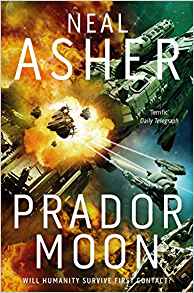
Prador Moon


A war between the Polity and the alien prador is often referred to in the later books. This prequel tells a story about its beginning. It’s a short action read and a good introduction that does not have the complications of the later books.

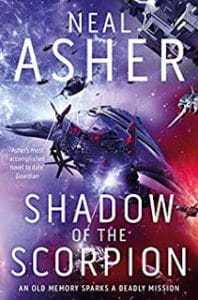
The Shadow of the Scorpion


This prequel tells the story of Ian Cormac growing into adulthood. He goes from childhood to military service in the ruination left by the prador-human war, is haunted by memories of his missing father and by the mysterious intermittent presence of a scorpion war drone.

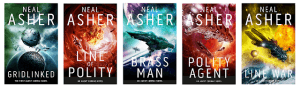
Agent Cormac


Cormac is now an agent of Earth Central Security. He starts being gridlinked i.e. had computer hardware in his skull linking him to the AI net, but is taken offline to recover his humanity as he investigates threats to humanity: separatists terrorists, a giant alien probe called Dragon, and ancient lethal alien Jain technology. The books are: Gridlinked, The Line of Polity, Brass Man, Polity Agent and Line War.

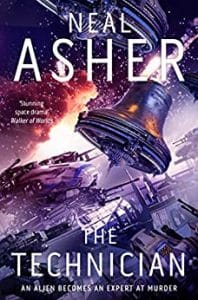
The Technician


This stand-alone Polity book tells the story set on the planet Masada, which appeared in The Line of Polity. It concerns the Atheter race who committed a form of racial suicide by sacrificing their intelligence two million years ago, a biomech war machine they left behind and an even more dangerous mechanism left to ensure their choice.

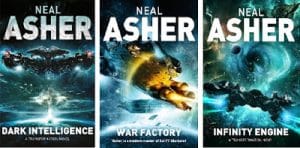
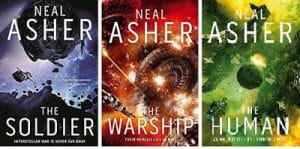
Transformation


A character in The Technician is the black AI called Penny Royal. This trilogy concerns a resurrected soldier from the war seeking to avenge an atrocity committed by Penny Royal during that conflict, restitution and absolution, and apotheosis.


Rise of the Jain


At the end of the Cormac series the haiman (a combination of AI and human) Orlandine is woken up by Dragon after two hundred years frozen. They have a job to do, which is to guard the Polity against an infestation of Jain technology in an accretion disk. Together they create a defence of thousands of giant weapons platforms, but Orlandine’s idea to hoover up the Jain tech using a black hole might not be the best one she had. . .

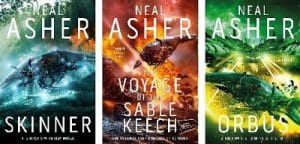
Spatterjay


Three travellers arrive on the oceanic planet Spatterjay, where humans are immortal and very tough by dint of a virus imparted by the leeches of that world, where living sails make contracts with the Old Captains on the ships and an ancient war drone called Sniper is growing bored. They are Janer, who carries the eyes of a hornet hive mind, Erlin who wants to find an Old Captain to teach her how to live, and Sable Keech a policeman who hasn’t allowed being dead for seven hundred years get in the way of hunting down villains. Things are about to turn nasty, what with the old enemy the prador and evil the Skinner arising.

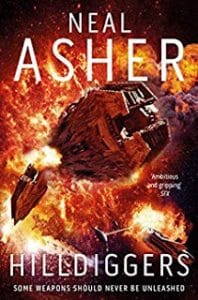
Hilldiggers


A Polity ambassador arrives in a system where a terrible war once raged between the two rival planets where the human inhabitants have ‘adapted’ to their worlds. He knows that during their war, one side captured a bizarre object suspected of being a cosmic superstring and is investigating. It is stored in the four Ozark cylinders of a massively secure space station in orbit. A woman fell pregnant while conducting research on this alien entity they now call ‘the Worm’, and gave birth to quads. Grown up now, one of this exceptional breed seems determined to gain total control of the deadly hilldiggers – giant dreadnoughts used to end that war.

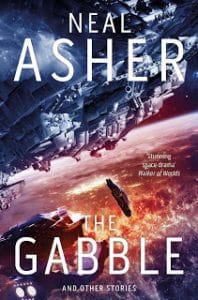
The Gabble


Finally here’s a collection of short stories mostly set in the Polity and often related to the events above. It can fill in some nerdish detail but it can also be a starting point if short stories are your thing.

So there you have it. You can follow through chronologically or you can sort of go by publication order. I leave it up to you. I will add, that from a recent discussion on all this, that for many readers it did not matter where they started. I’ve seen those that started from the end of the Cormac series with Line War, others who started with Dark Intelligence. In general, if you enjoy my writing, it doesn’t matter too much. You will find your way.

Happy reading!