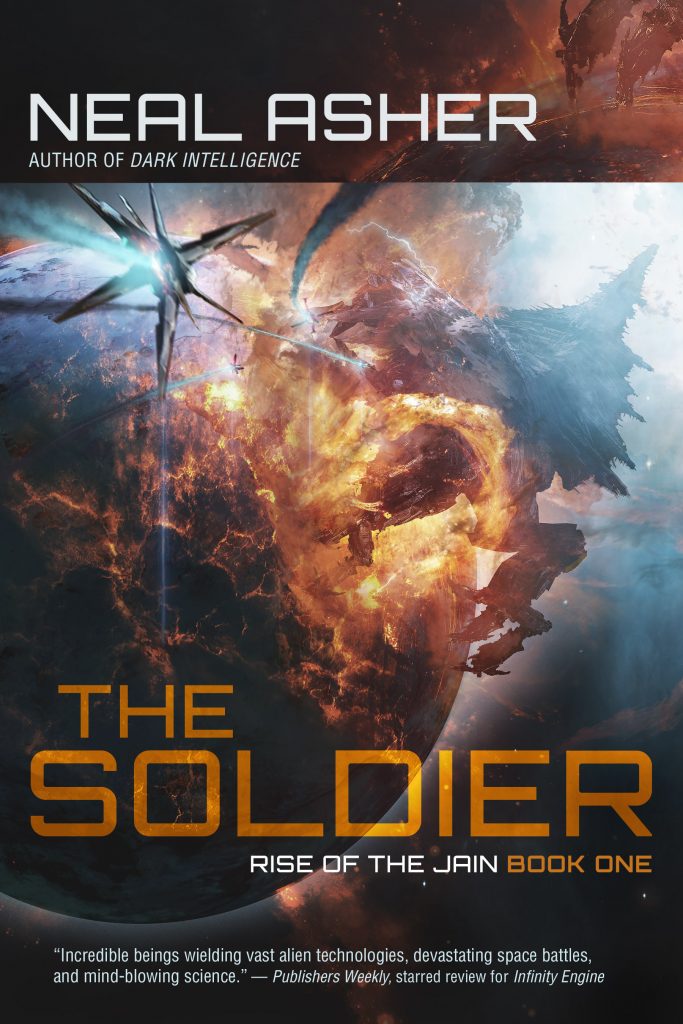
I just received this cover image of The Soldier, first book of Rise of the Jain from Night Shade Books in the US. Very nice.

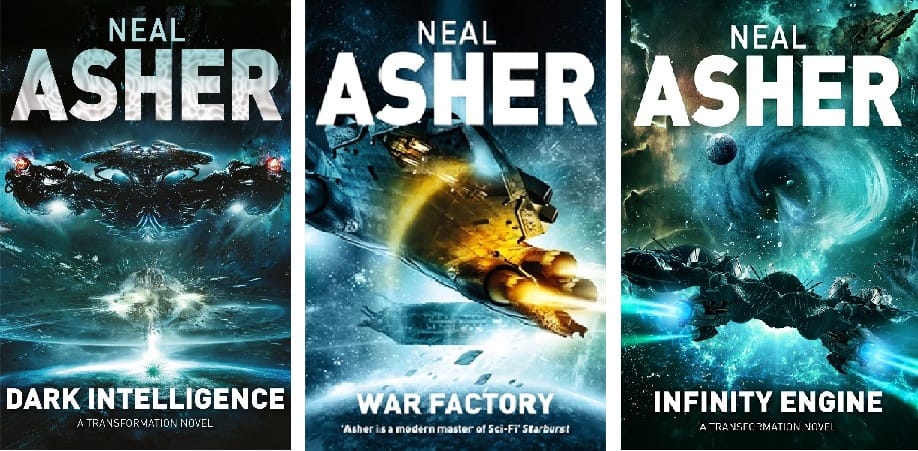
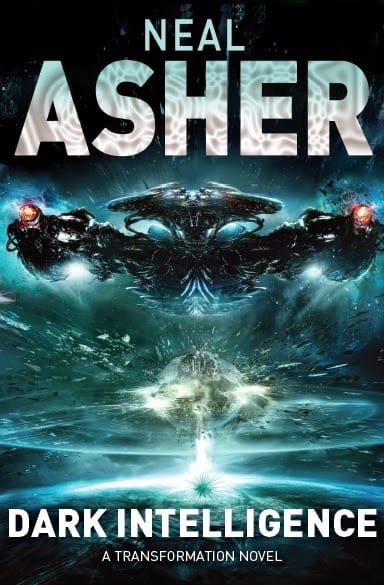
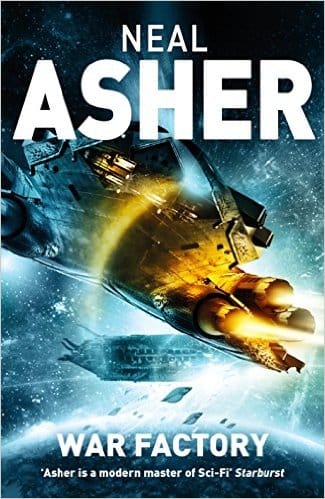
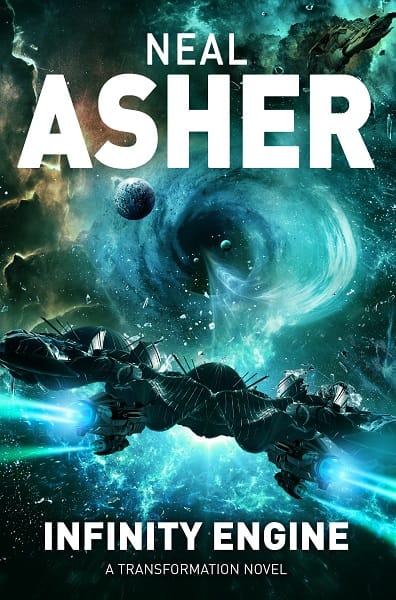
I’m clearing out some books in my loft so therefore selling some signed copies. Since there’s a right mixture up there I cannot be arsed to sort them all out and list them so will be putting batches up for sale like these. Okay, I have UK mass-market paperback editions of the Transformation trilogy to go. Those are Dark Intelligence, War Factory and Infinity Engine. The cost is cover price plus postage – the books are £9 each while p&p in the UK is £4 and to the US is £11 (for example). These can be just signed or signed to you. I can be tracked down on Facebook and Twitter or you can leave a message here.

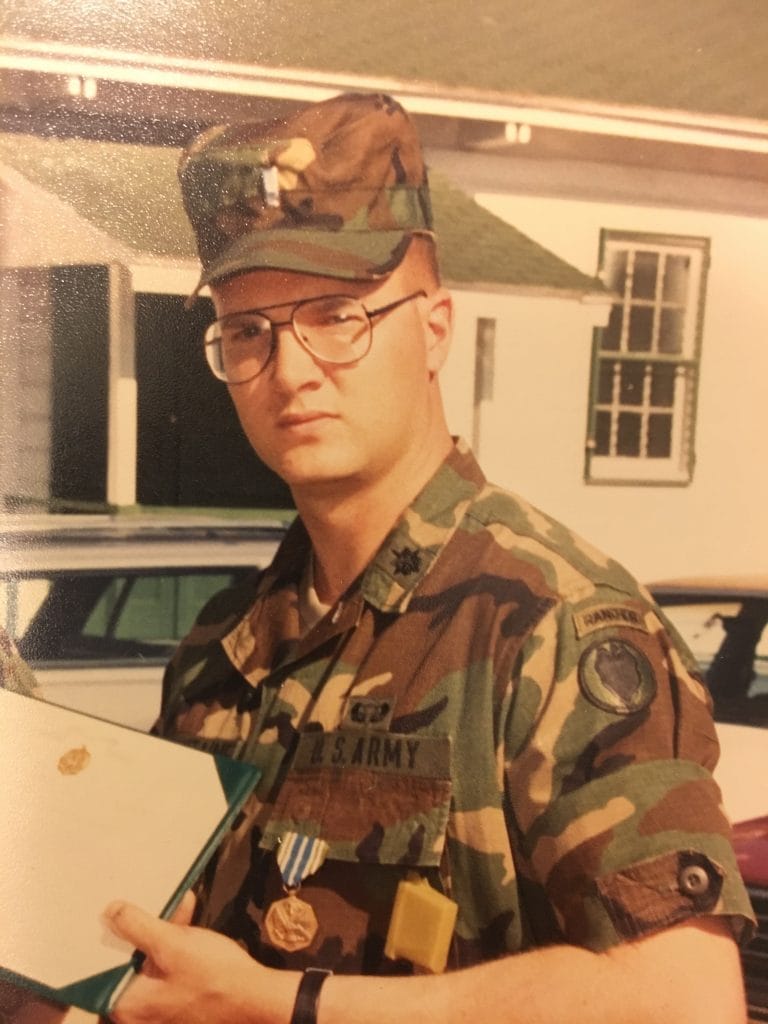
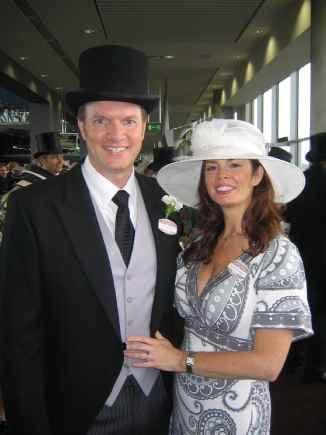
I’m Paul LaFontaine, currently living in Breckenridge, Colorado. Love the mountains, skiing, hiking and the outdoors.

I grew up on classic science fiction that had been written 20 years earlier – Heinlein, A.C. Clark, Asimov. Even went really old school E.E. Doc Smith and the Lensman series. Ursula K. LeGuin’s the Lathe of Heaven. The Forever War. Consumed books on nuclear war, mutants, plagues. Always military themes. Fleets, dropship troopers, Mega-tanks, mushroom clouds.
In 1980 I read a novelette in Omni magazine by a then little known writer named George R.R. Martin called Sandkings. My love of bio-based science fiction, kindled by the Bugs in Starship Troopers, was stoked into a roaring inferno by Martin’s Sandkings that would inevitably lead me to a bunch of crabby characters on a certain moon in the future.
My first human science fiction hero was Bel Riose, the hapless General in the failing Empire of Asimov’s Foundation Trilogy. Unstoppable when in command of his legendary 20th Fleet, the politicians ended his career. Aware of the thematic similarities only dimly as a teenager, I applied to and attended the United States Military Academy to become an officer in the Army of another empire in its twilight.

After deploying and participating in the First Gulf War and seeing how grimy and random war can be, I got out and tried business. Not particularly lucky or skilled, I was swept up into a bit of momentum when the internet happened. I got my first taste of the new capabilities that made Artificial Intelligence conceivable. I saw things at scale. Fast forward past a bunch of boring business stuff and I find myself sent to the UK to help build out the internet arm of the benevolent and beloved Ticketmaster. And it all began to come together – love of bio based science fiction, interest in AI and located in the UK where I was one short visit to a Waterstone’s away from crossing paths with Neal Asher’s work.

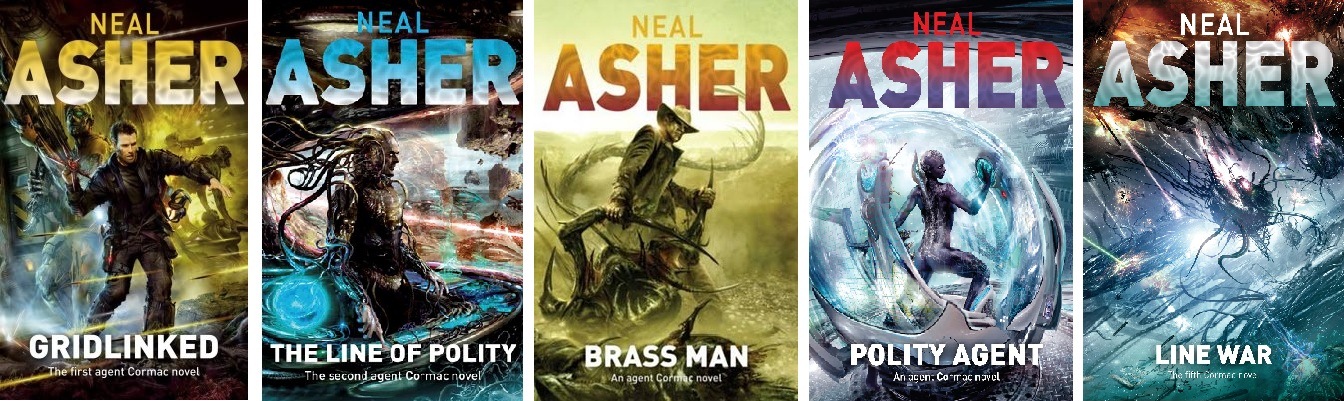
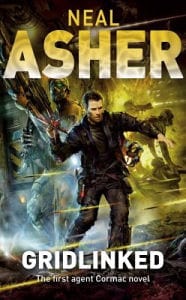
My first of Neal’s books was Gridlinked. I was blown away. Ian Cormac was a character I really connected with. The Polity had it all. AI, Golems, Sparkind, battle wagons, weird tech and critters of all types. Bless the Prador and the little children. Beware the Brass Man. Enjoy the creepy belly feel of picturing the reified Sable Keech.
I’ve read every book of Neal’s I can download. And that makes for some good reading.

I had a proud papa moment when my 24 year old son sent me a photo as he was deploying to the Middle East to participate in operations there. He took a pic of two books he had picked up for his trip. One was Dan Simmon’s Hyperion (a good one), and the other was Neal’s War Factory. A staple. I have taught him well.
Thanks Neal for your work!
The first two books of the Transformation trilogy are now available on Audible read by Peter Noble. Infinity Engine (the last) will be available on October 5th.


Gridlinked free! This is a promotion for Australian and New Zealand readers. Gridlinked is free for one week, from yesterday, featured in iBooks First in a Series Free. Spread the word! Repost!


I was born in 1975 and am still not dead. When I’m not sleeping, eating, teaching, fighting or seeing my girlfriend or my kids, I like to read weird books. Science fiction, esotericism, popular science, the obscure and arcane, general weirdness with hooks and jaw muscles that lock up and bleed you dry. Through the years I’ve been paid money to do different things, like selling people books, screaming at men dressed in camouflage, calling people named Chris (Wherever you need to call an office, ask for Chris. He knows EVERYTHING. Debt collection was no different. I’ve spoken to literally hundreds of people called Chris.) and trying to make kids believe in their ability to master the Oxford comma. I’m Ben. Hi.

I’ve been favourably likened to a crazed berserker, which is plainly a load of dingo’s kidneys. I do yoga and read books. I got hooked on science fiction in grade school, when one of my oldest and dearest friends and I would check out as many anthologies from the library as we could, and then spent afternoons throwing those books back and forth between each our sofa. The floor was lava. The books smelled like vanilla. Our minds reeled. He is a professor of organic chemistry today. I am a schoolteacher. Back then, we dreamed of travelling to distant worlds, building generational spaceships, breaking the lightspeed barrier, watching the event horizon of a black hole, time paradoxes, artificial intelligences, alien species, quantum physics and escaping a world’s gravity well by use of nanotube space elevators. We were ten.
Aged 15, I was given “The Hitchhiker’s Guide to the Galaxy” by Douglas Adams and laughed for a month. My mother would tell me she could hear me laughing through the wall and I had to go to school the next day, bright-eyed and bushy-tailed, or so help me. Twelve years later I wrote my Master’s dissertation on the canonicity of that book series, and I still can’t decide if it was a really clever piece of work or I was trying to shout louder than Adams’ detractors. Even his biographers insisted his works were nothing but light entertainment.

There’s a certain sensitivity to the hilarity of the almost irrationally grotesque that I’ve only found within the works of some very few authors, such as Adams, Iain Banks, Alfred Bester and of course Neal Asher. Too often, science fiction could become too drawn-out, too senselessly descriptive. As all the purists know, be they on the space opera or hard sci-fi side of the fence, the truly great science fiction is about humanity. And when you get right down to it, the history of humanity is a kaleidoscope of grisly, seemingly unbounded brutality, walking hand in hand with a very inappropriate sense of humour.
When I was little, my mother gave me a piece of advice that I never forgot. “You can do two things about life. You can laugh, or you can cry. Your choice.” Where I think Asher stood out from all the science fiction I voraciously consumed through my adult years was in how it transfixed me like a deer caught in a truck’s headlights, insecure about its future as a hood ornament. I had bought “The Gabble”. I had no clue.

For those of you not in the know (Shame on you. Seriously.), the Gabbleduck is an enigmatic, pyramidal life form that is arguably sentient, seemingly indifferent to other life forms and speaks in weird vocalizations that never. Ever. Repeat. It baffled me. There was an almost Lovecraftian horror to the Gabbleduck. It spoke of hidden horrors, a race that had collectively lobotomized themselves in an ancient conflict, for possibly draconian reasons. It was hilariously funny and mind-numbingly dreadful at the same time. It was like discovering that your kindly grandfather kept the livers of dead men in neatly labeled glass jars in a hidden room in his basement, and he invited you to inspect and admire his collection as he regaled you with the curious stories of how they ended up in his care, laughing with fondness and a twinkle in his eye. It was all for the glory of the Dread Voice from the Beyond. And here is my collection of rare, vintage toothpicks.
Needless to say, I read every single book I came across by Asher. I laughed. I was nauseated. I was intrigued. Sometimes I tasted that painful ache of existential angst that sometimes spills out, and curiously, on those occasions I’ve felt reassured as if by Neal’s own hand reaching out, telling me it’s OK. And it was better than OK. Even in an uncaring, senselessly brutal and frequently hilarious universe, it’s better to laugh than to cry. Shakespeare’s oft-quoted passage about life being a tale told by an idiot, full of sound and fury, signifying nothing is definitely not valid here.

On a related note, Shakespeare had so-called “trouble plays”, which defied categorization as either tragedy or comedy, somehow synergistically managing to create better comedy AND better tragedy at the same time. I like to think that Asher does something very similar in creating stories that straddle the gap between poignant tragedy and side-splitting comedy while still managing to keep their metaphorical trousers from splitting.
Keep writing books, please. I need them.
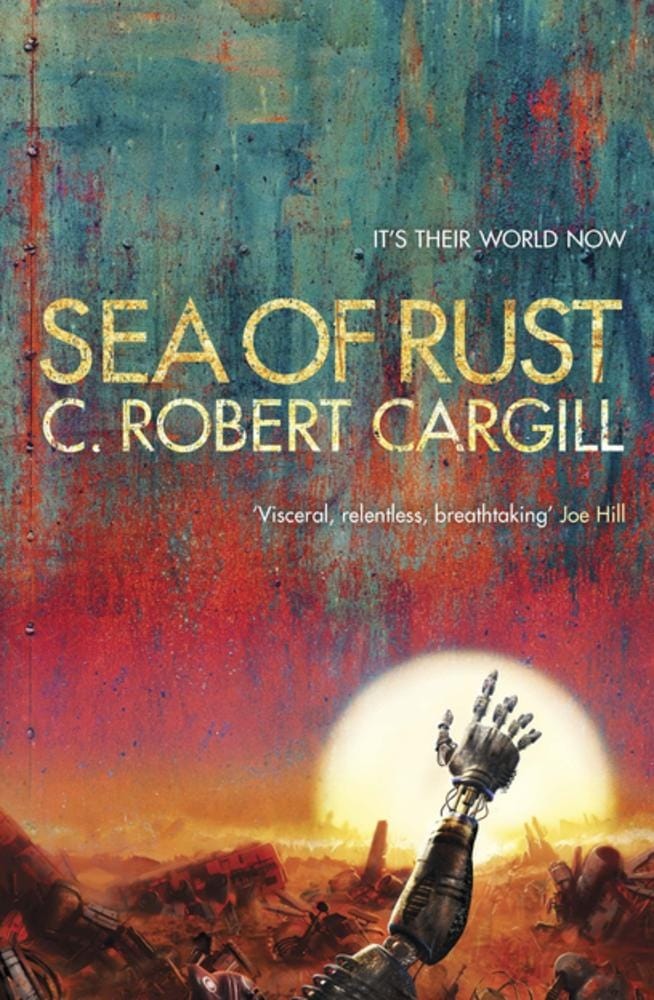
As you know I occasionally get books sent to me for comment. Some I don’t comment on because I don’t like them. The worst ones are those that are okay. How do I make a comment without damning by faint praise? But I had no real problems with this. Here’s what I sent back to the publisher:

Thanks for sending me ‘Sea of Rust’. I’ve read it now and here’s a few thoughts: I had my doubts at first reading a book without human characters but in the end that made no difference at all – they were human really. I did think it a bit US-centric and grimaced at the usual ‘red-necks are the bad guys’ stuff but otherwise I did enjoy it. The writing and story-telling were engaging and, despite them being robots I cared about the characters and more besides. In the end, robots with plasma weapons and chain-guns, battling in a post-apocalyptic world … what’s not to like?
Recommended.

Like everyone else who has contributed a bio so far, I have also read a great deal of science fiction, starting with Madeleine L’Engle’s A Wrinkle in Time at age seven and Podkayne of Mars by Robert Heinlein not long after that. I was hooked and have read many of the great authors that others have listed. You all have great taste in books! What caught my eye with Neal Asher’s Gridlinked in 2006. Here was an author who had more futuristic ideas scattered on every page than many SF authors had in their entire book! And he was introducing these new concepts with a single word!: aug, chainglass, plasteel, runcible, U-space, etched sapphires, the Polity. Mind Blown.

In The Skinner, again Asher introduced multitudinous mind-bending ideas as if they were commonplace and I loved his characters: the Old Captains, the war drones, the hive-mind, even the leeches. His understanding of biology was extensive and impressive. So many ideas spinning around in my mind, I thought I had found the motherlode! I have bought everything of his I can get my hands on. Still searching for a Mason’s Rats. Haha!

Neal said write about yourself and your life. I am a Canadian woman of Japanese descent. Both sets of grandparents came to Canada around the 1900s. My father’s family was interned during WWII in a camp as possible enemy aliens. They lost everything. My father never felt anger about what happened. These things happened in wartime. At least he was not deported to Japan and he survived the war. So many young men did not. I got to grow up in a country that allowed women to study medicine and become doctors. I originally was in a PhD program in Neurophysiology but I got bored so I completed a M.Sc. in Neuroscience before I went into medicine. I found research was not for me; no people contact!
I practiced as a family physician in a small rural town in Southern Ontario while I raised a beautiful son and a daughter with my husband, David. In Canada, people do not comment on the fact that I am Asian and David is Caucasian. I am Japanese heritage and David was born in England, I was baptized a Protestant and David a Catholic. People are most shocked that I am a physician and he is a chiropractor. Even that is being more accepted these days. That is Canada, for you.

What I really want to tell you about is the place I work. I am a surgical assistant at a community hospital in Southern Ontario and we are a United Nations at work. Everyone not only gets along, we love where we work and the individuals we work with. We have physicians – anesthetists, surgeons, gynecologists, internists from Azerbaijan, Cameroon, Canada, Egypt, Ghana, Iraq, Iran, Japan, Lebanon, Libya, Nigeria, Taiwan, Slovakia, etc. We have physicians who are Catholic, Protestant, Coptic Christian, Orthodox, Muslim, Hindu, Jewish, Atheist (I am not aware of any practicing Buddhists). We have gays, lesbians, transgender individuals and heterosexuals among all of the employees in the surgical department. I think our differences make us stronger. We Canadians appreciate so much more what we have because we work with people who have risked their lives, left their families, been in jail, and risked death to come to Canada. We learn about other people’s customs and they are not evil. I find it an honour and privilege to work with these individuals who have so much to give to our society. When one works towards a common goal – treating people and saving lives – differences in people don’t count. It is the humanity in us all that binds us together and makes us such a powerful force for the good of the community. I wish other countries could see our small hospital in action.

I began writing science fiction to try and give people a sense of what it is like to be in a medical facility where differences don’t matter. I placed the medical hospital in the future in space and used androids and robots to tackle the issue of prejudice. The books are humorous because I am a teeny weeny bit of a joker – not just with Neal. (It is a disease).
(The links are here if anyone is interested in checking them out. The first book, Welcome to the Madhouse by S.E. Sasaki, is free on most sites and the second book, Bud by the Grace of God, is available until end of September for $0.99. Then it returns to $4.99. I hope you enjoy them and they make you laugh out loud. Sorry for the shameless plug but Neal encouraged me more than once to put them in!)

https://www.amazon.co.uk/gp/product/B01LZC73OT/ref=series_rw_dp_sw
https://www.amazon.com/gp/product/B01K8PQZA0/ref=series_rw_dp_sw
If I can make one appeal on this blog, which reaches people from all over the world, please reach out to others who are not of your country, your race, your religion, your gender, your community and try and find common ground. The Other is not so scary or so different when you get to know him or her. Under the few millimeters of skin, we are all the same. I know. We open people up every day and everyone by and large are built the same on the inside. Why do people think the amount of melanin in the skin cells is so important? It’s not.
Thank you for your attention,
Sharon