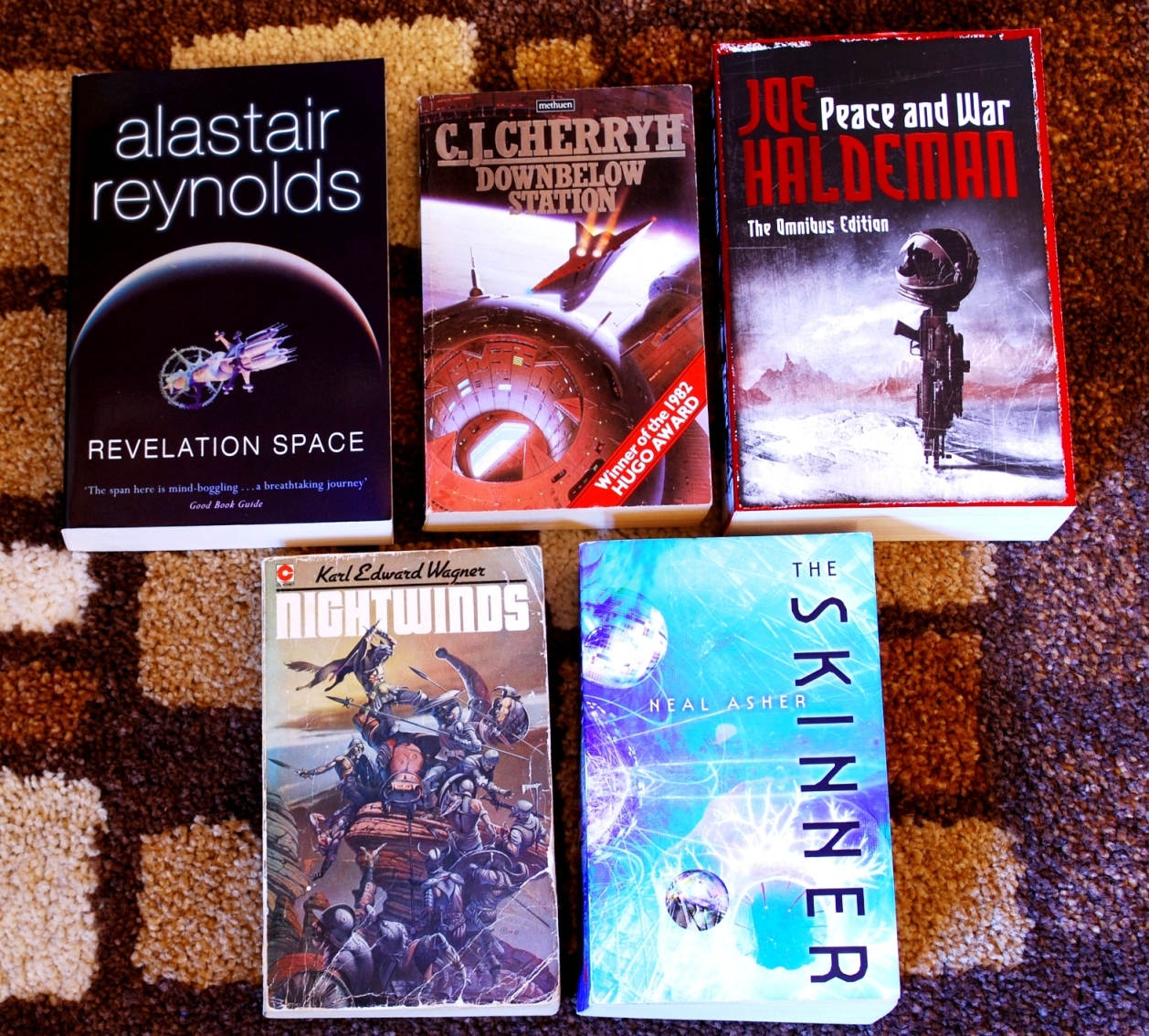
Z is for Zelazny, Mostly.

Here’s the last of my general SFF collection. I may yet put up something about the collectible books I’ve obtained since entering the publishing world too. But how about something from you? My brother suggested something along the lines of the first favourite five (alliteration there for those waiting for another ‘On Writing’). Send me a photograph along with some explanation of why you like the books, or maybe some history of your acquaintance with them.

GEORGE ZEBROWSKI:
THE OMEGA POINT

ROGER ZELAZNY:
JACK OF SHADOWS
ISLE OF THE DEAD
TO DIE IN ITALBAR
DEUS IRAE
LORD OF LIGHT
A DARK TRAVELLING
DAMNATION ALLEY
CREATURES OF LIGHT & DARKNESS
NINE PRINCES IN AMBER
THE GUNS OF AVALON
SIGN OF THE UNICORN
THE HAND OF OBERON
THE COURTS OF CHAOS
KNIGHT OF SHADOWS
PRINCE OF CHAOS
BLOOD OF AMBER
SIGN OF CHAOS
TRUMPS OF DOOM
MY NAME IS LEGION
DOORS OF HIS FACE THE LAMPS OF HIS MOUTH

Freeman Dyson Email Exchange.

I’m afraid there’s only one reaction possible to this: Steve Connor is a complete dick head. He gets the opportunity to have an email exchange with Freeman Dyson, arguably the greatest living scientist on Earth, and seeks to lecture him on global warming. He seeks to sell his religion to a man who, intellectually, could have him for breakfast. I understand Dyson’s exasperation and dismissiveness. It’s rather like seeing a chicken trying to out-fly and eagle.

A few of Dyson’s comments:

“My impression is that the experts are deluded because they have been studying the details of climate models for 30 years and they come to believe the models are real. After 30 years they lose the ability to think outside the models.

Unfortunately things are different in climate science because the arguments have become heavily politicised. To say that the dogmas are wrong has become politically incorrect. As a result, the media generally exaggerate the degree of consensus and also exaggerate the importance of the questions.

Of course I am not expecting you to agree with me. The most I expect is that you might listen to what I am saying. I am saying that all predictions concerning climate are highly uncertain. On the other hand, the remedies proposed by the experts are enormously costly and damaging, especially to China and other developing countries. On a smaller scale, we have seen great harm done to poor people around the world by the conversion of maize from a food crop to an energy crop. This harm resulted directly from the political alliance between American farmers and global-warming politicians. Unfortunately the global warming hysteria, as I see it, is driven by politics more than by science. If it happens that I am wrong and the climate experts are right, it is still true that the remedies are far worse than the disease that they claim to cure.

I wish that The Independent would live up to its name and present a less one-sided view of the issues.

With all due respect, I say good-bye and express the hope that you will one day join the sceptics. Scepticism is as important for a good journalist as it is for a good scientist.”

Here at the end Dyson has realized he was talking to an idiot, but decided to conclude the interview politely. Go and read the whole thing if you can stomach it.

Oh, and let me just add this from the comments:

Freeman Dyson, B.A. Mathematics, Cambridge University (1945), Research Fellow, Trinity College, Cambridge University (1946–1947), Commonwealth Fellow, Cornell University, (1947–1948), Commonwealth Fellow, Institute for Advanced Study, Princeton University (1948–1949), Teaching Fellow, University of Birmingham (1949–1951), Professor of Physics, Cornell University (1951-1953), Fellow, Royal Society (1952), Professor of Physics, Institute for Advanced Study, Princeton University (1953-1994), Chairman, Federation of American Scientists (1962-1963), Member, National Academy of Sciences (1964), Danny Heineman Prize, American Physical Society (1965), Lorentz Medal (1966), Hughes Medal (1968), Max Planck Medal (1969), Enrico Fermi Award, United States Department of Energy (1993), Professor Emeritus of Physics, Institute for Advanced Study, Princeton University (1994-Present)

Notable: Unification of Quantum Electrodynamics Theory.

Why Cities Will Save Us, Or Not.

You know, I’m really getting sick of people who fail to understand the meaning of ‘correlation does not imply causation’. It’s right getting on my tits. Prime examples of this daftness are scattered through an article in the Radio Times by a guy called Doug Saunders titled ‘Why Cities Will Save Us.

Apparently, after the shift of the peasant population to a livelihood based on large cities and commercial farms ‘the consequences were an end to starvation and large scale infant mortality … and a shift to smaller family sizes and small stable populations’. Maybe there’s some truth here concerning more efficient farming, but ‘commercial farms’ have been with us since money was invented. Anyway, to conflate better food production with ‘large cities’ and imply that both resulted in an end to the problems listed above is plain silly. But then the devil here is of course in the detail since this guy doesn’t want logic to get in the way of him singing the praises of the cities.

No, Doug, there was more money to be earned in the towns because of industrialization, less to be made on the land, for labourers, because of more efficient farming practices stemming from that industry and even less when the landlord started chucking them out because he wanted more wool to feed the looms. Those starving in ten-to-a-room hovels with shit running down the street outside carried on breeding and dying in large numbers. Industry drove the demographic changes that turned towns into the cities as we know them. Better technology (drugs and food production) cut down infant mortality and enabled smaller family sizes, and the populations were stable before the Industrial Revolution. The cities you love are an incidental result of industry and nothing more.

The next stinger is this one: ‘Village life is a major killer: according to the World Food Program, three quarters of the billion people living in hunger are peasant farmers.’ Did you spot the major confusion of correlation of with causation? Here, let me have a go with this kind of twisted logic: Fresh air is a major killer: three quarters of a billion people living in hunger live in the countryside. Apparently the positioning of a colon has a magical effect.

No, Doug, three-quarters of a billion people are living in hunger because they haven’t got enough food.

Then we get: ‘The move to the city, almost everywhere, results in a large improvement in rates of nutrition, longevity, infant mortality etc.’ No, Doug, that was the farming and the technology, remember? Oddly enough cities don’t spontaneously generate food or invent drugs.

Essentially the article continues in this vein. Apparently cities are the cure for the world’s ills, which would have come as a surprise to Alexander Fleming, Louis Pasteur, Jethro Tull, John Snow and others on a rather large list of names which should also include the inventors of the condom and the contraceptive pill.

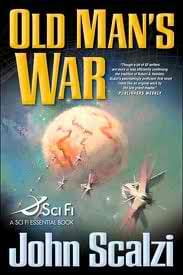
Old Man's War Movie

Well this should be pretty damned cool!

EXCLUSIVE: Paramount Pictures has acquired screen rights to the John Scalzi novel series Old Man’s War, with Wolfgang Petersen attached to direct and David Self adapting the tale into a large-scale science fiction project. Scott Stuber will produce through his Stuber Pictures banner, with Petersen also producing. The hero is a 75-year old man who, having lost the love of his life, is amenable to trading his old carcass for a younger, genetically enhanced body so that he can combine the experience of age with the strength of youth and join an outer space military coalition sent to protect human colonies in outer space. Inductees agree to leave their past lives on earth behind, and are promised land on distant human colonies if they live. Injured in battle, he’s rescued by a special-forces officer who seems to be a younger version of his wife. She doesn’t recognize him, but he’s so convinced he has another chance with her that he abandons his unit and risks everything to be with her. Kim Miller will be exec producer and Alexa Faigen is associate producer. Scalzi is a two-time Hugo Award winner who was most recently creative consultant on the TV series Stargate: Universe. Old Man’s War is the first title in a bestselling series that spans four books.

The Nemesis List — R J Frith

I wasn’t going to write a criticism of this book because I do have some negative things to say and, really, I don’t like doing that. I much prefer to give a good review of something I enjoy and ignore what I haven’t enjoyed (and probably haven’t finished). However, on balance, I’ve come to the conclusion that the good outweighs what I see as the bad in some of the biggest and most fundamental ways. Why have I come to this conclusion and why have I changed my mind?

Just recently I delved into a large tome produced by someone who is supposed to be a big shot in the fantasy genre and after about twenty or thirty pages started to lose the will to live. It was utterly boring. It was swords and sorcery transforming into soap opera. Next I picked up a big fat science fiction tome and the effect was precisely the same though took a shorter time to take effect. Both these books are published, both by supposedly proven writers. R J Frith the winner of the War of the Words competition hosted by Tor UK and Sci Fi Now magazine gives us The Nemesis List, and it is worth your attention.

My particular gripe is that Jeven Jones, the main protagonist of this who is a ‘fast-tracked evolutionary leap into the future’ comes across as pretty ineffectual and damaged considering that there seem to be vast dark forces trying to track him down. Throughout the book there was the promise of something extraordinary from him but it didn’t seem to arrive. I wanted to give him a slap and tell him to sort himself out, which I guess shows how well he comes across as a character. I could also see that the Jeven Jones character was quite similar to the girl with psychic powers in Firefly. But you really have to remember that all this is my subjective response.

Now to why I think it’s good: I read it from cover to cover without any feeling that I was losing interest or wanted to put it down. I enjoyed this book and, frankly, if there’s a follow-up I want to read it. It was dark, quite assured, and Frith can get you to emotionally invest. I am, even now, considering reading it again to see if I can get a better handle on it, and that doesn’t happen often with me.

Do I recommend it? It’s flawed but promising and yes, I do, because whilst some of you out there will hate it, I rather suspect that there will be others who will think it is the best thing they’ve read in a while.

Guns, Germs and Steel.

Having heard about the book Guns, Germs and Steel by Jared Diamond (I think it was Richard Morgan who recommended it) I managed to pick up a copy from a local charity shop. However, when I tried to read it my eyes started glazing over and I ended up sticking it to one side. It then ended up in that pile of books destined to be sent to a charity shop under the label ‘Life’s too Short’.

A number of weeks ago I then noticed a Channel 4 documentary with the same title and recorded it. Just yesterday, feeling knackered after having to get up at 4.15AM to drive my mother to Gatwick, I decided to do something less mentally taxing so sat down to watch it.

The essential question posed was, ‘Why have the Europeans always been the winners?’ Why have they generally been ahead of the rest of the world? Jared Diamond’s reasoning is essentially this: most of the animals that can be domesticated are only found in Eurasia, which took farming in this region beyond the subsistence level thus freeing up human resources for technical and social development e.g. the smelting of metals like steel and really, the building of civilization. This domestication of animals also led to an increase in the diseases the Eurasians suffered and subsequently gained some immunity to. So, armed with steel, rapidly developing technology and a shitload of diseases they went off and conquered the world.

This is, of course, a simplification. The documentary itself was almost certainly a simplification of the book.

A particular case cited is that of the Conquistadors. Armed with steel, experience of warfare and mounted on horses, Francisco Pizarro and his men first defeated the Incas in battle (mainly because of the naïve stupidity of their emperor), then the small pox the Spanish carried finished off the job. Yes, historical fact, but was it necessary to imply in this documentary that the small pox was somehow deliberate?

The logical thread of this is very attractive and certainly has much truth. However, the continuous use of the liberal buzz-word ‘inequality’ throughout should have clued me in to how specious some of the reasoning was. The first hiccup was with that domestication of animals and non-subsistence farming. This happened in the Middle East and with a bit of hand-waving and talk about how it spreads latitudinally, it magically became the big advantage to the people of Europe. One then has to ask the question: why wasn’t it the middle easterners with their ‘guns, germs and steel’ conquering the rest of the world? I’ll take the forgiving view that this is all a bit more complicated than portrayed in the documentary, so perhaps I really should read the book.

Next we go to tropical South Africa which the Europeans struggled to conquer because their farming methods didn’t work and because the diseases were on the side of the Africans. However, the Europeans did win there because the steel was on their side – mainly the Maxim machine gun, then the train. Okay, I get that – more historical facts. But what got my back up here was the glorification of the native and the life style of the ‘noble savage’. And please stop it with the implication that the Europeans destroyed some wonderful agrarian idyll and that a return to that life style might be a good thing. Yes, the life-span in the place depicted is about 40 now, but did those ‘noble savages’ live any longer? Did the women enjoy popping out baby after baby until dying of it? Did they all enjoy labouring every day just to put food in their mouths?

Diamond then moved away from his central contention to claim that the similarities between tribal languages indicated a previous single underlying language and an African civilization, on the bones of which the Europeans built their African empire. I can see the point of the language thing when we look at the ‘romance languages’ and the like. If you want to you can contend that the Europe we know is ‘built on the bones’ of earlier civilizations (The Greeks and then the Romans). Thing is, we’re still digging up those bones. Nothing remains of this particular African civilization because they built nothing long-lasting and invented no more than had already been current in the Stone Age, which is a curious and highly convenient definition of civilization.

It would have been better if this had stuck to Diamond’s original contention about ‘guns, germs and steel’ rather than straying into the apologia and fatuous fact-twisting of political correctness.

In the end this documentary was another of those liberal self-flagellation fests; another deep revel in white guilt and the present practically Luddite attitude towards technology. It was highly selective of its ‘facts’, quite good at confusing correlation with causation (another common one nowadays). Yes, I perfectly understand the point that no single race possesses some underlying superiority, but I damned well disagree with the idea here that because luck and circumstance put the Europeans on top that they should feel guilty and be all apologetic. The reality of this documentary is that those who produced it don’t really understand their own proposition of underlying equality, which is that if the ‘guns, germs and steel’ had arisen elsewhere in the world, it would have been the Europeans who got the kicking.

Strange isn’t it, how the politically correct revel in a guilt that stems from their own assumed superiority.
Noblesse oblige.

Books in Outland, Trondheim – Norway

Two pics for you from probably the best bookstore I have ever been in. A proper store that sells it all from Manga to GFX Novels to ‘proper’ books.

The guy in the picture works there and was very happy to be photographed. He has your website so hopefully he will pop on and say hi!

We have 3-4 book shops here with your stuff but we only need the best one 🙂

Sorry about the blurry 2nd image, old knees…

Hitch.

Books in Waikele, Hawaii.

Thanks to Sean Price for sending this picture. He was a bit reluctant. I’ll let him explain why.

I was hesitant to send you this picture but then I realized you’re probably more interested to see how well you sell–or not–in various places instead of just getting pictures that give you an ego boost.
(Um, I quite like ego-boosts – Neal)

I’m not sure what to make of the meager selection except to attribute it to Border’s financial woes. They’ve filed Chapter 11 and after visiting the store it’s apparent that this was not a sudden decision. When I first discovered your books–several years ago–you had an entire row, hardback and paperbacks included. Now…not so much. However, this isn’t just your books. The pickings are very slim–even for the pulp authors with numerous titles–so I’m guessing that Borders is just not replenishing their stock. Lots and lots of empty shelves…

A fair selection of books from the Best Seller lists but back stock for authors…? It’s like crickets chirping on most of the aisles.

I rarely visit the store anymore since I do the majority of my book buying through Amazon (Kindle) so I hadn’t realized how bad it’s gotten.

I suppose I could visit the Barnes and Nobles store down in Waikiki, but that will have to wait as I rarely have the patience (or willpower) to deal with the traffic situation down that way. 🙂